

Last Updated: November 13, 2026
Quick Summary
Melanated skin requires specialized makeup formulation because standard products treat deeper complexions as a shade extension rather than a distinct chemistry problem, causing shades to turn orange, gray, or ashy. Melanin varies in concentration and undertone, changes how pigment behaves with depth, and reacts more visibly to irritation, so formulas need higher pigment load, proper dispersion, and barrier-friendly bases.
- A 2025 American Chemical Society report covered a blue cosmetic color additive developed for darker foundations.
- Higher pigment concentration delivers fuller coverage from a thinner layer that flexes with expression lines.
- Poorly dispersed pigment leaves clusters that read as speckling and patchiness on deeper skin.
- Our Melanin Match Liquid Foundation spans 16 shades across warm, cool/red, neutral, and olive undertones.
- Test flashback by photographing the finished look with flash in dim light before an event.
Table of Contents
- Why Standard Makeup Formulation Misses Melanated Skin
- How Melanin Changes the Way Skin Responds to Makeup
- Pigment Concentration and Color Payoff in Specialized Makeup Formulation
- Foundation for Dark Skin Tones: Shade Depth, Undertone, and White Cast
- Makeup for Hyperpigmentation That Covers Without Caking
- Makeup for Sensitive Skin: Barrier-Friendly Formulas for Melanated Complexions
- Testing for Wear, Flashback, and Finish on Deeper Skin
- Find Your Shade With a Melanin-Based Matching System
- Frequently Asked Questions
Why Standard Makeup Formulation Misses Melanated Skin
Most makeup is built on a formulation model that treats deeper complexions as a shade extension rather than a distinct chemistry problem. That is the core reason why melanated skin requires specialized makeup formulation, and it is why so many products still turn orange, gray, or ashy by mid-afternoon.
The gap is measurable. In 2025, the American Chemical Society reported on a blue cosmetic color additive developed specifically to give darker powder and stick foundations the warmth and depth existing pigment sets could not reach. When a major scientific body is still solving basic color problems for deep shades, the standard formulation playbook clearly was not written for this skin.
Here is what that playbook gets wrong, and what a formula built for melanin does instead.
How Melanin Changes the Way Skin Responds to Makeup
Melanin is the pigment produced by skin cells that determines complexion depth and influences how skin reacts to light, irritation, and topical products. Its concentration varies substantially across individuals and is shaped by genetics, UV exposure, and even some medications, according to a 2023 review of skin pigmentation published in PMC.
That variability matters for makeup in three practical ways:
- Undertone is rarely one-dimensional. Deep complexions commonly carry warm, cool, neutral, and olive undertones, sometimes in combination. A single "deep" shade category cannot capture that.
- Pigment behavior changes with depth. The same iron oxide ratio that reads neutral on light skin can read red or gray on deeper skin.
- Reactivity runs higher. Richer melanin is often accompanied by a skin barrier that reacts more visibly to irritation, which shows up as darkening rather than redness.
Pigmentation, Post-Inflammatory Hyperpigmentation, and the Coverage Gap
Post-inflammatory hyperpigmentation is darkening that remains after inflammation or injury to the skin, and it is one of the most common reasons melanated skin seeks coverage. A 2024 review of cosmetic considerations in dark-skinned patients notes that cosmetic planning for darker complexions warrants specific attention to skin characteristics and concerns.
Pigment Concentration and Color Payoff in Specialized Makeup Formulation
Color payoff depends on how much pigment reaches the skin, how evenly those particles are spread, and how much light the film reflects back.
Pigment load. Higher pigment concentration delivers color payoff with less product, which means fuller coverage from a thinner layer. That thinner layer is the whole game: it covers hyperpigmentation without the cakiness that comes from building up a weak formula. A thin, pigment-dense film also flexes with expression lines instead of cracking over them, which is why a well-built deep shade can look smoother at hour eight than a sheer formula layered three times.
Pigment dispersion. Concentration is only half the story. Iron oxides and other mineral pigments are fine powders that clump unless they are properly wetted out and dispersed through the base. Poorly dispersed pigment leaves microscopic clusters that read as speckling, patchiness, or a dull, flat cast, and on deeper skin those clusters are far more visible because the contrast between pigment and skin is lower.
Particle size and light behavior. Smaller pigment particles scatter more light and can read cooler or more ashy; larger particles read deeper and warmer but can feel grittier. That is why the same iron oxide ratio that reads neutral on light skin can read red or gray on deeper skin, the skin beneath is contributing its own reflected color, and the pigment film has to work with that reflectance rather than against it.
Binder-to-pigment ratio. The trade-off formulators manage is texture. Push pigment too high without enough binder and the formula turns dry and powdery on deeper skin, where any ashiness is immediately visible. Push binder too high and coverage goes sheer and slips. Balance it with emollients and the coverage stays comfortable while the pigment still hides discoloration.
Base chemistry. The oil, wax, and water phase determines how pigment sits on skin and how it oxidizes through the day. A base that is too volatile can flash off and leave pigment sitting on top of the skin; a base that is too rich can migrate into fine lines.
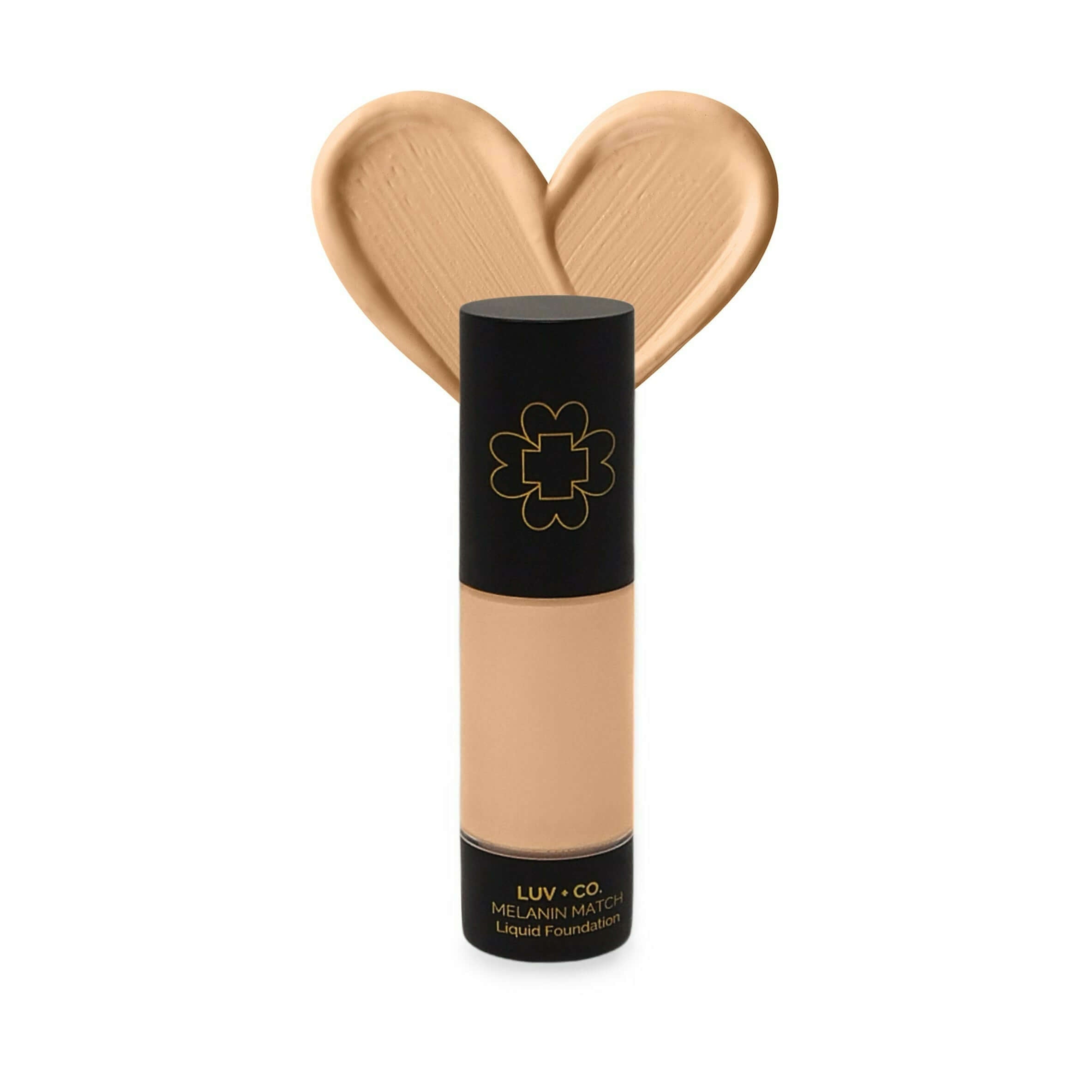
Our Melanin Match Liquid Foundation uses medium, buildable coverage with mineral-based pigments, sodium hyaluronate for hydration, and organic jojoba seed oil, with a natural matte finish.
Foundation for Dark Skin Tones: Shade Depth, Undertone, and White Cast
White cast is the pale, chalky film left when a formula's base pigments are lighter than the skin beneath them. On deeper complexions it reads as gray or ashy, and it is the single most common complaint about foundation for dark skin tones.
- Depth: how light or deep the complexion is
- Undertone: the warm, cool, neutral, or olive cast beneath the surface
- Opacity: how much the base pigment masks the skin versus letting it show through
Our Melanin Match Liquid Foundation spans 16 shades across warm, cool/red, neutral, and olive undertones, and our HD Cream Foundation + Concealer skews intentionally deeper across 14 shades for medium-to-full coverage. If ashy foundation is already your daily reality, our guide on how to stop foundation looking ashy walks through the fixes step by step.
Makeup for Hyperpigmentation That Covers Without Caking
Covering hyperpigmentation without caking comes down to layering targeted coverage over a hydrated base, not flooding the whole face with full-coverage product. Concentrate the pigment where the discoloration is and keep the rest of the complexion light.
Our HD Cream Foundation + Concealer is built to be used all over or tapped only onto dark spots and under-eye discoloration, which keeps the finish smooth instead of heavy. For a full technique walkthrough, see our guide on how to cover hyperpigmentation on melanated skin.
Makeup for Sensitive Skin: Barrier-Friendly Formulas for Melanated Complexions
Makeup for sensitive skin on melanated complexions has a higher bar, because irritation does not just sting, it can leave a dark mark behind. Barrier-friendly means fewer known irritants, no talc, and a formula that hydrates rather than strips.
Our Melanin Match Liquid Foundation is vegan, talc-free, and paraben-free. Our Natural Lift Mascara is made for sensitive eyes, and our Non-Toxic Moisturizing Lipstick is dye-free.
Testing for Wear, Flashback, and Finish on Deeper Skin
Flashback is the white or gray reflection a product throws back under camera flash, and it shows up far more on deeper skin than on light. The cause is usually reflective ingredients, certain sunscreen filters, silica powders, and light-scattering particles, that bounce light back at the camera instead of letting it pass into the skin. Testing for it means photographing the finished look with flash before an event, not after.
Three checks worth running on any new base:
| Test | How to Run It | What Failure Looks Like |
|---|---|---|
| Flashback | Photograph with flash in dim light | Gray or white cast across the face |
| Wear | Check at 4 and 8 hours | Patchy breakdown, orange shift |
| Finish | View in daylight, not indoor light | Chalky or flat appearance |
Define measurable criteria up front. Useful measures include shade-match accuracy (does the swatch disappear into the jawline in daylight?), color payoff (does one pass deliver the intended opacity?), cast visibility (is there a gray or white shift under flash?), wear time (when does the first patch of breakdown appear?), oxidation (does the shade shift warmer or cooler over the day?), and user-reported comfort (tightness, itch, or transfer). Naming the measure keeps the test honest and separates evidence from marketing claims.
Find Your Shade With a Melanin-Based Matching System
A melanin-based system reads depth and undertone together rather than forcing deep skin into seasonal color categories.
At LUV + CO., our LUV LAB uses a proprietary Melanin Analysis process to match shade to your complexion. You can read how melanin analysis for makeup works before you book, or order foundation and concealer samples to test shades on your own skin first. When you are ready to commit, our Melanin Match Liquid Foundation comes in 16 shades built across four undertone families.
Finding a foundation that covers hyperpigmentation without turning gray, and a mascara that will not irritate sensitive eyes, should not require trial and error across a dozen brands. LUV + CO. formulates specifically for melanated, sensitive skin, with vegan and talc-free formulas developed by a beauty product development PhD, plus a Melanin Analysis shade matching system built for deeper complexions. Get started with LUV + CO. and find your shade with confidence.
Frequently Asked Questions
Why can makeup shades look different on melanated skin?
Melanin absorbs and reflects light differently than lighter skin, so a shade that looks correct in the bottle can turn orange or ashy once applied. Formulators have to account for pigment concentration, undertone, and how mineral pigments interact with deeper skin depth.
How do undertones affect foundation for dark skin tones?
Undertone is the warmth, coolness, or neutrality beneath your surface color, and it decides whether a foundation reads as a match or a mask. Two people at the same depth can need completely different undertones: yellow or golden, red or cool, neutral, or olive. A foundation line built for melanated skin should map shades by both depth and undertone. LUV + CO.'s Melanin Match Liquid Foundation, for example, offers 16 shades across warm, cool/red, neutral, and olive undertones.
How can makeup for hyperpigmentation cover dark spots without looking ashy or cakey?
The trick is buildable coverage in layers rather than one heavy application. Start with a lightweight liquid foundation to even the overall tone, then use a concentrated cream formula only on the spots that need more. LUV + CO.'s Melanin Match HD Cream Foundation + Concealer is designed for targeted coverage of hyperpigmentation and dark spots, and it skews deeper across 14 shades.
What should people with melanated, sensitive skin look for in makeup?
Look for short, clearly listed ingredient decks, mineral pigments, and formulas that hydrate rather than strip. Avoid talc and heavy fillers when you can, and patch test anything new. LUV + CO. builds its complexion products around sodium hyaluronate and organic jojoba seed oil, and its Natural Lift Mascara is made for sensitive eyes. Our Non-Toxic Moisturizing Lipstick is dye-free. When in doubt, order samples before committing to a full size.
