

Table of Contents
- What Melanin Analysis Means for Melanated Skin
- How Melanin Analysis Works: From Melanocytes to Shade Match
- The Chemistry of Color-Correcting for Melanin-Rich Skin
- DIY vs. Professional Skin Tone Analysis: What Actually Works
- Best Makeup for Discoloration: What to Look For
- How to Choose Foundation for Hyperpigmentation
- Frequently Asked Questions
Last Updated: September 16, 2026
What Melanin Analysis Means for Melanated Skin
Melanin analysis for makeup is the process of measuring how melanin is distributed and expressed in your skin so a foundation or concealer can be matched to your actual complexion instead of a generic shade label. At LUV + CO., we built our shade-matching system around this idea because standard color analysis was never designed with Black skin in mind. Here's the short version: two women can wear the same foundation depth and still need completely different undertones.

Why Traditional Undertone Matching Falls Short
Most in-store shade matching relies on a single question: warm, cool, or neutral? That framework assumes pigmentation behaves the same on every complexion.
It doesn't. Melanated skin contains a mix of pigment types that shift how light reflects off the surface, and a quick wrist swatch under fluorescent lighting captures almost none of that. A common mistake is testing foundation on the back of the hand, where skin tone rarely matches the face.
How Melanin Analysis Works: From Melanocytes to Shade Match
Melanocytes are the cells that produce melanin, and melanin analysis reads the pigment those cells create rather than guessing from a surface swatch. The process starts inside the melanocyte, where the enzyme tyrosinase converts the amino acid tyrosine into a precursor called dopaquinone. From there, the pathway branches: one route produces eumelanin, the brown-to-black pigment, and another produces pheomelanin, the red-to-yellow pigment. Those pigments are then packaged into tiny structures called melanosomes and transferred to surrounding skin cells, where they sit above the cell nucleus and absorb UV radiation before it can damage DNA.
That biology is why two people with the same visible depth can need completely different foundation shades. The ratio of eumelanin to pheomelanin, the size and density of the melanosomes, and how evenly the pigment is distributed across the face all change how light behaves at the skin's surface.
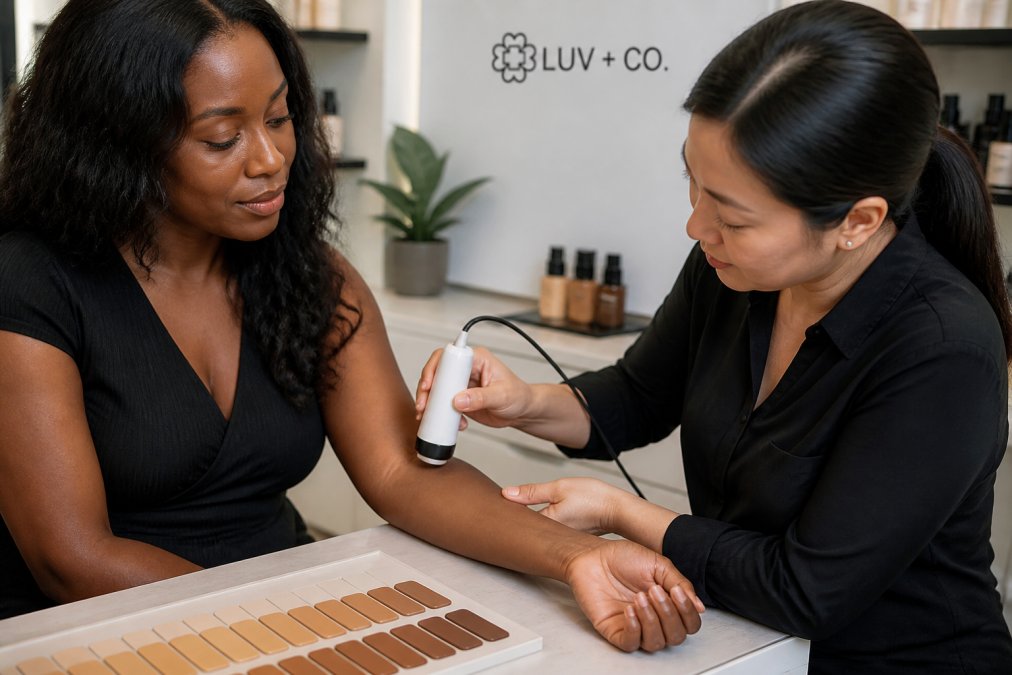
What a Device Actually Measures
When a professional analysis tool is placed against the skin, it is not "seeing" your melanin directly. It is measuring how your skin reflects and absorbs light across a range of wavelengths, then translating that reflectance data into a pigment profile. Spectrophotometers typically read a narrow band of visible wavelengths and return a color value; hyperspectral imaging systems capture many more wavelength bands at once, which lets them separate surface tone from underlying pigment and even flag areas of uneven melanin distribution, such as melasma or post-inflammatory hyperpigmentation.
The practical output is a set of values describing depth, undertone, and how your skin reflects light, three variables, not one. That is the core difference between analysis and a swatch.
Eumelanin, Pheomelanin, and What They Mean for Color
Higher eumelanin generally means deeper, richer color with less visible redness. More pheomelanin pushes toward golden, red, or peach undertones. Olive undertones sit in a harder-to-read middle zone, where a greenish or grayish cast can appear even when depth is matched correctly.
This matters because foundation pigment has to account for all three variables at once. A formula built only around depth will match the lightness of your skin while ignoring the undertone entirely. A formula built around undertone but not reflectance will look right indoors and wrong in daylight.
Professional analysis looks at pigment concentration, undertone, and how your skin reflects light.
| Method | What It Measures | Best For | Limitations |
|---|---|---|---|
| Drugstore swatching | Surface depth only | Quick estimates | Misses undertone shifts |
| DIY at-home kits | Depth plus rough undertone | Building a starting range | Limited shade accuracy |
| Phone-based shade-matching apps | Depth and approximate undertone from a photo | Online ordering without a store visit | Sensitive to lighting and camera calibration |
| Professional melanin analysis | Pigment type, undertone, light reflection | Precise foundation matching | Requires an appointment |
That ratio also explains why the same depth can look completely different from one person to the next, and why a shade that works in one formula can fail in another with the same label.
The Chemistry of Color-Correcting for Melanin-Rich Skin
Color-correcting works on the principle that opposite colors neutralize each other on the color wheel, and melanin-rich skin needs different corrections than lighter complexions. The reason is not cosmetic preference, it is pigment density. When melanin concentration is high, the skin absorbs more light across the visible spectrum, which shifts how underlying discoloration reads. Hyperpigmentation on deeper skin often carries a blue, purple, or gray cast rather than the red or brown cast it takes on lighter skin, and that shift changes which corrector actually neutralizes it.
Here's what most guides miss: corrector placement matters as much as corrector color. Applying a heavy layer under the eyes and then building foundation on top is a fast route to a cakey finish. The corrector should sit only on the discolored area, be pressed in with a fingertip or small brush, and be allowed to set for a moment before foundation goes over it.
Melanin Analysis Appointment →
Why Peach and Orange Beat Green on Melanin-Rich Skin
On the color wheel, blue sits opposite orange, and purple sits opposite yellow. That is why peach and orange correctors work on the blue-to-purple casts common in deeper complexions: they cancel the cool cast directly. Green correctors, by contrast, sit opposite red. They are useful for calming visible redness, but on melanin-rich skin redness is rarely the dominant discoloration, so green applied broadly tends to mute the complexion instead of evening it.
The density of your melanin also affects how much corrector you need. Higher eumelanin means the skin reflects less light back, so a corrector that looks subtle on lighter skin can read as a visible patch on deeper skin.
- Peach corrector: neutralizes blue-toned under-eye discoloration
- Orange corrector: targets deeper brown and purple hyperpigmentation
- Yellow corrector: brightens dull or grayish areas without adding warmth
- Green corrector: calms visible redness, used sparingly on melanated skin
- Use thin layers and build gradually rather than applying one heavy coat
Matching Corrector to Foundation Undertone
Once the correction is in place, foundation should go on in thin layers and be built up only where coverage is still needed. The goal is not to cover the corrector, it is to blend it into the surrounding skin so the corrected area reads as the same tone as the rest of the face.
DIY vs. Professional Skin Tone Analysis: What Actually Works
Professional analysis offers accuracy.
The honest trade-off: DIY costs less and takes minutes, while professional analysis costs more. If you have significant hyperpigmentation or have cycled through failed matches before, the professional route can be beneficial.
Best Makeup for Discoloration: What to Look For
The best makeup for discoloration combines buildable coverage with pigments that match melanated undertones, and skips ingredients that irritate sensitive skin. Coverage alone is not the answer; a formula that hides dark spots but dries out your skin creates a new problem. Achieving this balance requires a precise approach to color theory, as the most effective products rely on your ability to identify skin undertones to ensure the pigment complements rather than masks your natural complexion.
Look for these qualities:
- Buildable coverage rather than a single heavy layer
- Undertone-specific shades, not a universal "deep" range
- Hydrating ingredients that keep the finish from looking flat
- Talc-free and paraben-free formulas for sensitive skin
- Mineral pigments that blend without a gray cast
How to Choose Foundation for Hyperpigmentation
Choosing foundation for hyperpigmentation starts with identifying your undertone before your depth, then matching coverage level to how much discoloration you want to even out.
Follow this order:
- Identify your undertone: warm, cool, neutral, or olive
- Determine your depth level within that undertone
- Decide your coverage need: medium buildable or medium-to-full
- Test in daylight on your jawline and neck
- Build in thin layers and set with a tinted powder
Frequently Asked Questions
Is melanin analysis the same as skin undertone matching?
No. Undertone matching looks at whether your skin leans warm, cool, neutral, or olive. Melanin analysis goes further by examining how melanin concentration and distribution across your skin affect the way pigments appear once applied. Two people can share the same undertone but need different foundation depths and color-correcting strategies because their melanin levels differ. Melanin analysis combines depth, undertone, and melanin behavior to produce a more accurate shade match for melanated skin.
How does melanin concentration affect foundation shade matching?
Higher melanin concentration changes how light interacts with your skin and with pigment particles sitting on top of it. Foundations with insufficient pigment depth can appear differently on high-melanin skin. Melanin analysis accounts for this by measuring pigmentation levels before recommending a shade.
Why is it difficult to formulate makeup for high-melanin skin?
High-melanin skin has different chromophore absorption patterns, meaning the same red or brown pigment can look completely different depending on melanin concentration. Formulating accurately requires testing across a wide range of melanin levels, adjusting pigment ratios, and avoiding ingredients like titanium dioxide that can create a chalky cast on deeper skin.
What are the benefits of using melanin-aware makeup products?
Melanin-aware products are formulated with pigment systems that respect the depth and undertone of melanated skin. Benefits include natural-looking coverage without a gray or ashy cast, better camouflage of hyperpigmentation and dark spots, and formulas that hydrate rather than strip sensitive skin. For people dealing with discoloration, a melanin-aware foundation can even out tone while still letting your skin look like skin.