

Table of Contents
- Why Your Foundation Turns Ashy: The Science of Oxidation and Pigment
- Foundation Undertones Explained: Finding Your True Match
- How to Color Correct Dark Spots Before Foundation
- Prep Your Skin Canvas: Exfoliation and Hydration Steps
- Best Makeup for Discoloration: Formulas That Fight Ashiness
- Application Techniques and Lighting Checks to Stop Ashy Foundation
- Fixing Ashy Foundation: Quick Troubleshooting and Product Swaps
- Conclusion: Your Next Steps to a Flawless Finish
- Frequently Asked Questions
Last Updated: September 24, 2026
Why Your Foundation Turns Ashy: The Science of Oxidation and Pigment
That gray, lifeless cast on your jawline isn't your imagination. It's chemistry. Learning how to stop foundation looking ashy on melanated skin starts with the pigments in the formula not matching your undertone, or oxidizing after they hit the air and your skin's natural oils.
Here's the part most guides skip: ashiness is a contrast problem, not a coverage problem. Titanium dioxide and zinc oxide, the two minerals behind most full-coverage foundations, are naturally white. On deep skin, that white base sits on top of your complexion instead of blending into it. The result is a grey cast that no amount of blending can fix.
Oxidation makes it worse. As the formula reacts with oxygen and your skin's sebum, the pigments shift, often turning orange or darker within an hour of application. According to cosmetic chemistry resources from the American Chemical Society, pigment stability varies widely by formula, which is why one foundation holds its color all day while another shifts by lunch.
LUV + CO. formulates specifically around this problem, using mineral pigments across 16 shades built for melanated skin rather than adapted from lighter ranges.
Foundation Undertones Explained: Finding Your True Match
Undertone is the subtle hue beneath your skin's surface that stays consistent whether you're tan or pale. It's different from depth, which is how light or dark your skin is. You can be deep in depth and cool in undertone, or medium in depth and warm. Most shade-matching failures happen because a brand matched your depth and ignored your undertone.
Here's how to find your undertone:
- Warm/yellow: golden or yellow warmth shows through, veins look green
- Cool/red: red or rosy tones dominate, veins look blue or purple
- Neutral: a balance of both, veins look like a mix
- Olive: a green-gold cast, often confused with warm
Grey vs. Ashy vs. Oxidized: A Diagnostic Chart
Most people use "ashy" to describe three different problems, then buy the wrong fix. Before you change shades, identify which one you actually have:
| What you see | What it usually means | First thing to try |
|---|---|---|
| Flat grey cast immediately on application | Undertone mismatch, a cool or neutral formula sitting on warm or olive skin | Swap to a warmer or olive-leaning shade, or add a warm corrector drop |
| Grey that deepens over 30-60 minutes | Oxidation, pigments reacting with oxygen and sebum | Switch to a more stable mineral pigment formula; check your primer base |
| White or chalky film, especially in photos | Titanium dioxide or zinc oxide flashback | Remove those minerals from foundation, powder, and SPF |
| Patchy grey only on certain areas | Dryness or texture grabbing pigment unevenly | Prep and hydrate before changing shade |
That distinction matters because the fixes don't overlap. Adding warmth to an oxidized foundation makes it orange. Adding orange to a flashback problem does nothing. Diagnose first.
Why the Vein Test Fails on Deeper Skin
The vein test, green means warm, blue means cool, was built around lighter complexions where veins show through translucent skin. On deeper skin, melanin obscures the veins, so the test often reads neutral or gives a false cool result. A more reliable check is the drape test: hold a warm gold fabric and a cool silver fabric under your jaw in daylight. Whichever makes your skin look even and healthy, rather than sallow or grey, points to your undertone family.
A second reliable check is the foundation jaw stripe: apply three candidate shades in vertical stripes along your jaw, blend the bottom edge only, and look at them in daylight after 20 minutes.
How to Color Correct Dark Spots Before Foundation
Color correction neutralizes discoloration before foundation ever touches your skin. Skipping this step is why full-coverage foundation still looks gray over hyperpigmentation.
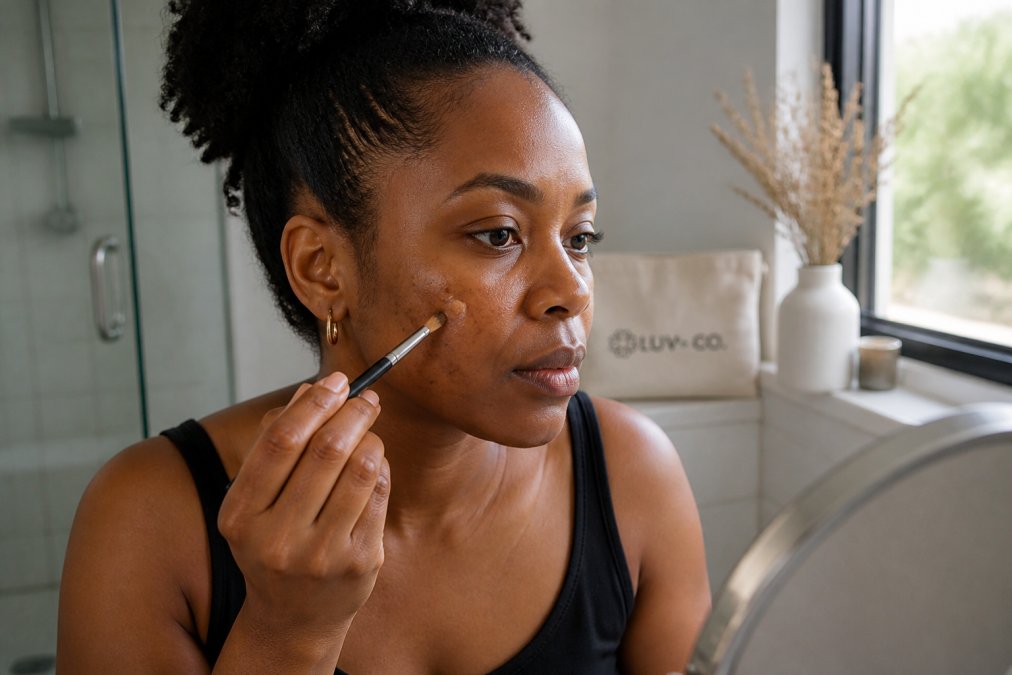
Use the color wheel:
- Peach or orange cancels blue and purple tones in dark spots and under-eye circles
- Green cancels redness from acne or irritation
- Yellow brightens dull or purple-brown areas
Prep Your Skin Canvas: Exfoliation and Hydration Steps
Follow this order:
- Exfoliate gently two to three times a week to lift dead skin cells
- Hydrate with a moisturizer while skin is still damp
- Prime with a lightweight base to smooth texture
- Wait two minutes before foundation so products settle
A primer made for sensitive skin helps foundation glide instead of sitting on top of texture. LUV + CO.'s Chamomile Face & Eye Primer uses chamomile hydrosol and organic jojoba to create a soft, conditioned base without a heavy feel.

Best Makeup for Discoloration: Formulas That Fight Ashiness
The best makeup for discoloration combines mineral pigments with hydrating ingredients so coverage never turns dry or gray. Formula matters as much as shade.
Look for:
- Mineral-based pigments that blend into melanin rather than sitting above it
- Hyaluronic acid or sodium hyaluronate to attract moisture
- Jojoba or similar oils for comfortable wear
- No titanium dioxide in setting powders, which causes the chalky look
| Product Type | What to Look For | What to Avoid |
|---|---|---|
| Liquid foundation | Mineral pigments, hydrating base | Heavy white mineral bases |
| Cream foundation | Concentrated pigment, oil-free | Drying matte formulas |
| Setting powder | Tinted or semi-translucent | White translucent powder |
Application Techniques and Lighting Checks to Stop Ashy Foundation
Application technique decides whether your shade reads true. Even a perfect match looks ashy if you apply it wrong, and the most common cause isn't your brush, it's what's underneath your foundation.
The Primer Base Problem Nobody Warns You About
Primers and foundations are built on one of two bases: silicone or water. When you layer a water-based foundation over a silicone-based primer (or the reverse), the two don't bond. The foundation sits on top of the primer film instead of merging with it, and that separation reads as a grey, floating cast, especially on deeper skin where any lift in the pigment is visible.
SPF and Oxidation: The Two Chemical Culprits
SPF flashback is one culprit. Titanium dioxide and zinc oxide in sunscreen and foundation reflect light and create a white cast in photos. If you're being photographed, choose a formula without those minerals or skip the flash.
- Blot before you reapply. Oil sitting on the surface accelerates the shift. Press, don't wipe, so you don't disturb the pigment underneath.
- Set with a tinted powder, not a white one. White translucent powder on deep skin is the fastest route to ashiness, and it also feeds the grey cast as the day goes on.
Application Order That Prevents Ashiness
Do this:
- Apply foundation in thin layers, building where you need coverage
- Use a damp sponge or dense brush to press product into skin
- Blend down the neck and past the jawline
- Check your face in natural daylight before you leave
The Lighting Trap
Overhead bathroom lighting and warm indoor bulbs both lie about your foundation. Overhead light casts shadows that darken the jaw and make a warm formula look cooler than it is; warm bulbs push everything yellow and hide a grey cast. The only reliable check is indirect daylight, stand near a window facing away from direct sun, look at your jawline in a hand mirror, and compare it to your neck.
Fixing Ashy Foundation: Quick Troubleshooting and Product Swaps
Already ashy? You can fix it without starting over.
- Too gray: mix in a drop of warm or orange corrector
- Too orange: blend a cool-toned powder over the top
- Chalky finish: mist with hydrating spray and press with a damp sponge
- Oxidized by midday: switch to a formula with more stable mineral pigments
For setting, swap white translucent powder for a tinted option. White powder on deep skin is the fastest route to ashiness. LUV + CO.'s Melanin Magic Tinted Translucent Setting Powder is a semi-translucent mineral formula made for medium to deep skin, with no titanium dioxide or silica in the loose formula.

Conclusion: Your Next Steps to a Flawless Finish
Ashiness comes from mismatched undertones, oxidizing pigments, and formulas built for lighter skin. Fix the match, prep your canvas, and correct before you cover.
Find your shade and stop fighting your foundation.
Frequently Asked Questions
What to do if foundation looks ashy?
If your foundation looks ashy, it usually means the undertone clashes with your skin or the formula is oxidizing. Start by checking your undertone in natural daylight. If you see a grey or white cast, switch to a foundation with warm, neutral, or olive undertones. Color correct dark spots with peach or orange before applying foundation. Also, prep skin with exfoliation and a hydrating primer to prevent dryness that amplifies ashiness.
Does SPF cause foundation to look ashy?
Yes, some sunscreens with titanium dioxide or zinc oxide can leave a white cast, especially on deeper skin tones. This cast can make foundation appear ashy. Wait a few minutes for SPF to absorb fully before applying foundation.
How do I choose the right undertone for my skin?
To choose the right undertone, test foundation shades on your jawline, not your hand, and check in daylight. Brands like LUV + CO. offer 16 shades with warm, cool, neutral, and olive options.
Why does my makeup get ashy throughout the day?
Makeup can turn ashy during the day due to oxidation, where pigments react with your skin's natural oils and air, shifting color. Dry skin can also absorb moisture from foundation, leaving a powdery, ashy look. To prevent this, use a hydrating primer, set with a tinted powder like Melanin Magic Tinted Translucent Setting Powder, and avoid heavy powder layers. Blot excess oil gently instead of adding more powder.
Getting the right shade shouldn't feel like a gamble. LUV + CO. pairs 16 Melanin Match Liquid Foundation shades with a Melanin Analysis matching system built for Black skin, so you get coverage that evens hyperpigmentation without a gray cast. Test shades at home with mini collections, or visit the studio for a professional match. Find your shade and see the difference a true match makes.