

Table of Contents
- Start With Skin Prep That Supports Your Barrier
- The Best Color Corrector for Dark Spots on Melanated Skin
- How to Choose Concealer for Deep Skin Tones
- Step-by-Step: How to Cover Hyperpigmentation Without a Gray Cast
- Why a Non-Toxic Concealer for Acne Scars Matters
- Texture, Lighting, and Layering: What Most Guides Miss
- How to Cover Hyperpigmentation on Melanated Skin: Common Mistakes to Avoid
- Frequently Asked Questions
Last Updated: September 20, 2026
Start With Skin Prep That Supports Your Barrier
So before color corrector ever touches your face:
- Cleanse gently with a non-stripping formula
- Apply a hydrating moisturizer and let it absorb for 2-3 minutes
- Use a vitamin C serum in the morning if your skin tolerates it
- Wait for each layer to settle before the next
At LUV + CO., customers often tell us mainstream brands left them orange or ashy. The fix starts before makeup.
The Best Color Corrector for Dark Spots on Melanated Skin
The best color corrector for dark spots on melanated skin is a peach or orange-toned cream, not a green or purple one. Peach neutralizes blue-gray tones. Orange cancels deep brown and purple-brown pigment.
Here's a quick guide:
| Your Spot Looks | Corrector Color | Why |
|---|---|---|
| Blue-gray | Peach or salmon | Warm tones cancel cool shadows |
| Deep brown | Orange or red-orange | Orange neutralizes brown pigment |
| Purple-brown | Peach-orange mix | Balances both cool and warm tones |
| Greenish | Red or coral | Red cancels green |
How to Choose Concealer for Deep Skin Tones
Choosing concealer for deep skin tones comes down to three things: undertone match, buildable coverage, and a formula that won't oxidize.
Look for these in a concealer:
- Warm, neutral, or olive undertones (not cool-only)
- Cream or liquid texture that blends into skin
- Non-comedogenic formula if you're acne-prone
- No talc if you want a cleaner option
Step-by-Step: How to Cover Hyperpigmentation Without a Gray Cast
Covering hyperpigmentation without a gray cast means correcting the tone first, then building coverage in thin layers. Skip the corrector and no concealer looks right.
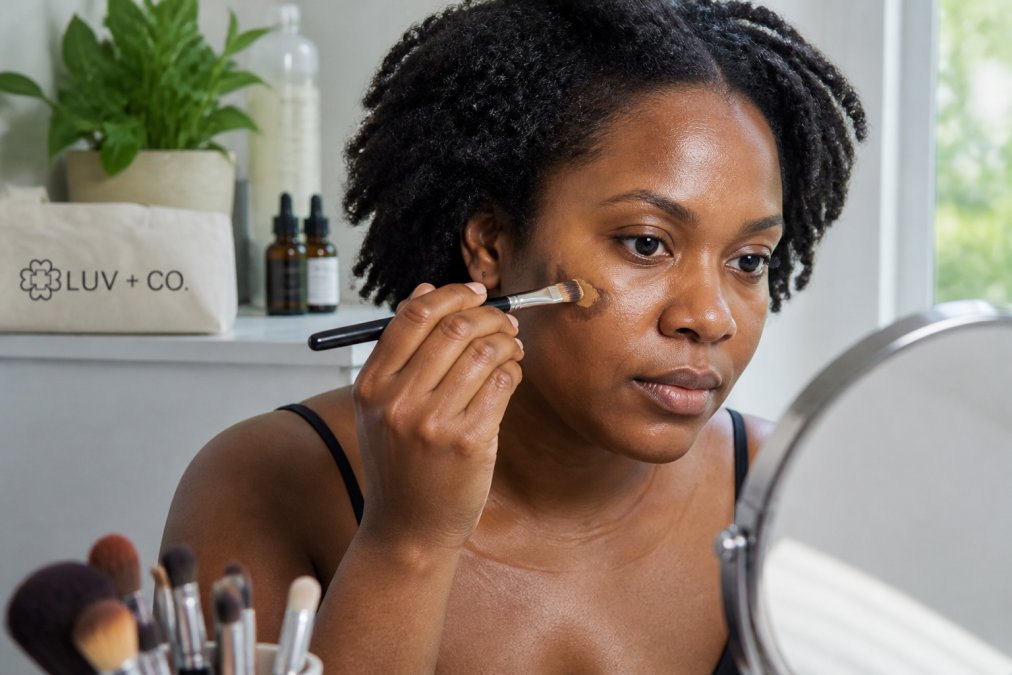
Step 1: Color Correct First
Apply a thin layer of peach or orange corrector directly on the dark spot. Tap it in with your ring finger or a small brush. Don't rub.
Step 2: Apply Buildable Concealer or Cream Foundation
Use a cream concealer or cream foundation with medium-to-full buildable coverage. Tap, don't swipe. Build in thin layers until the spot blends into your skin.

Step 3: Set With a Melanin-Friendly Powder
Traditional translucent powders are often too pale. They leave a chalky, gray look on deeper complexions. Use a tinted semi-translucent powder made for medium-to-deep skin.
Why a Non-Toxic Concealer for Acne Scars Matters
A non-toxic concealer for acne scars matters because scarred skin is already compromised, and textured hyperpigmentation is a different coverage problem than flat dark spots. Most guides treat every dark mark the same. They aren't.
Here's how to handle each:
Atrophic scars (indented):
- Skip heavy cream concealers that pool in the dip. Use a lighter liquid or serum concealer.
- Tap around the edge of the scar with a small flat brush, not into the center, blending across the depression drags product into it.
- Press (never sweep) a finely milled powder so it doesn't emphasize the crater.
- A blurring primer on just the scarred area can soften the shadow.
Raised or keloidal scars:
- These catch light differently than surrounding skin, so they read as a different color even when pigment is matched.
- Use a matte formula, shimmer and dewy finishes highlight the bump.
- Apply a slightly darker concealer to the base of the bump and your match shade on top to flatten the light reflection.
- Powder more heavily than on flat skin; the matte finish reduces the highlight.
Ingredients to avoid if you're acne-prone or actively healing scars:
Melanin Match HD Cream Foundation + →
- Talc (can clog pores and sit in scar depressions)
- Parabens
- Synthetic fragrances
- Heavy mineral oils
- Denatured alcohol in high concentrations (strips the barrier around healing tissue)
Ingredients that support skin while you wear them:
- Vitamin C (ascorbic acid) for brightening
- Green tea extract for soothing
- Niacinamide, which most practitioners find helps with both tone and texture over time
- Non-comedogenic moisturizers Selecting the right shade of concealer relies on a clear understanding of these active ingredients in harmony with the natural warmth or coolness of your complexion, which becomes much simpler once you find your skin undertone.
Texture, Lighting, and Layering: What Most Guides Miss
Texture, lighting, and product layering separate a good application from a great one, and almost no guide talks about them.
Texture: Match the Formula to the Surface, Not Just the Shade
Two people with the same depth and undertone can need completely different concealers depending on skin texture.
Oily or combination skin:
- Cream concealers slide and separate by mid-day. Look for a liquid or a cream-to-powder formula.
- Set with a light dusting of tinted powder across the whole area, not just the spot.
- A mattifying primer on the T-zone helps, but skip it on dry patches.
Dry or dehydrated skin:
- Powders cling to flakes and make hyperpigmentation look worse, not better.
- Use a cream or balm concealer and skip setting powder entirely on the dry areas.
- Exfoliate gently 24 hours before, not the morning of, freshly exfoliated skin is more reactive and more likely to flake under makeup.
Mature or thinning skin:
- Heavy cream formulas settle into fine lines around the eyes and mouth.
- A serum or fluid concealer with buildable coverage layers better than a thick cream.
- Apply with a damp sponge rather than a brush to avoid dragging.
Textured or scarred skin:
- See the acne scar section above, the rule is tap around, not into, any depression.
Lighting: Why Your Bathroom Lies to You
Bathroom lighting is usually warm (around 2700K) and dim, hiding the two things melanated skin is most prone to: gray casts and oxidation.
- Natural daylight (5000-6500K) is the honest test. Do your final check near a window, facing the light, not with your back to it.
- Office lighting is often cool fluorescent (around 4000K) and will make warm-toned correctors look more orange than they did at home. If you work under fluorescents, test your look under one before you commit.
- Phone camera flash is the harshest test of all. If your coverage survives a flash photo, it survives anything.
- Daylight-balanced bulbs (labeled 5000K or 6500K) are the closest at-home substitute when you can't get to a window.
Layering: Which Skincare Actives Conflict With Makeup
Here's a quick compatibility check:
| Layer | Works With | Avoid Pairing With |
|---|---|---|
| Water-based primer | Water-based concealer | Silicone-based formulas |
| Silicone-based primer | Silicone-based concealer | Water-based formulas |
| Cream corrector | Cream or liquid concealer | Powder foundation |
| Tinted setting powder | Any cream or liquid base | Heavy translucent powders |
| Vitamin C serum | Most liquid concealers (after full absorption) | Silicone primers applied too soon |
| Retinoid (night before) | Nothing on top the next morning without buffering | Direct concealer over flaking skin |
| Mineral sunscreen | Cream and liquid bases | Some chemical sunscreen formulas |
These are the details that make the difference between "your makeup looks nice" and "wait, you have hyperpigmentation?"
How to Cover Hyperpigmentation on Melanated Skin: Common Mistakes to Avoid
The biggest mistakes when you cover hyperpigmentation on melanated skin are using the wrong corrector shade, skipping prep, and setting with the wrong powder. Each one undoes the others.
Watch for these:
- Using green or purple corrector. Those work for redness on lighter skin. On melanated skin, they create gray.
- Going two shades lighter with concealer. This is the fastest route to an ashy, gray finish.
- Skipping moisturizer. Dry skin makes every product look patchy.
- Sweeping powder instead of pressing. Sweeping moves the product you just applied.
- Testing in bathroom light only. You'll miss oxidation and gray casts.
- Layering silicone over water-based products. They don't mix.
Frequently Asked Questions
What color corrector works best for dark spots on melanated skin?
Peach and orange correctors work best for brown and deep-brown dark spots because they neutralize the blue-gray undertone that shows through hyperpigmentation. Red neutralizers suit cooler, purple-toned spots. Apply a thin layer only on the spot, then blend the edges before adding concealer. LUV + CO.'s Melanin Match HD Cream Foundation + Concealer can double as a targeted cover step once the corrector has set.
How do I choose the right concealer shade for hyperpigmentation?
Match your concealer to your foundation shade, not a lighter one. Going two or more shades lighter creates a gray or ashy patch over dark spots. Test two or three neighboring shades along your jawline in natural daylight and let them settle for a few minutes before deciding. LUV + CO.'s Foundation & Concealer Samples let you try shades at home before committing to a full size.
Can makeup make hyperpigmentation worse on sensitive skin?
Makeup itself does not deepen hyperpigmentation, but irritating formulas can trigger inflammation that leads to new post-inflammatory hyperpigmentation. Fragrance, harsh preservatives, and heavy fillers are common culprits. Choose talc-free, non-comedogenic formulas and always patch test. LUV + CO. products are formulated for melanated sensitive skin and are free of talc, parabens, and other ingredients that commonly cause reactions.
How do I prevent makeup from looking ashy on deep skin tones?
Ashy results usually come from three things: a concealer that is too light, a translucent powder with a white base, and skipping color correction. Use a corrector under your concealer, match your concealer to your skin tone, and set with a tinted powder made for medium to deep complexions. LUV + CO.'s Melanin Magic Tinted Translucent Setting Powder is designed to set makeup without the chalky cast that traditional white powders leave behind.