

Table of Contents
- The Clean Beauty Paradox: When 'Natural' Triggers Irritation
- How Common Botanical Allergens in Cosmetics Cause Contact Dermatitis
- The 'Clean' vs. 'Preserved' Paradox: Why Fewer Preservatives Create More Problems
- The Fragrance Factor: Essential Oils and Sensitization
- How to Patch Test Skincare Products to Prevent Irritation
- Safe Makeup Brands for Sensitive Skin: What to Look For
- Post-Irritation Recovery: Restoring Your Skin Barrier
- Frequently Asked Questions
Last Updated: September 22, 2026
The Clean Beauty Paradox: When 'Natural' Triggers Irritation
Walk into any beauty aisle and you'll see the same promise on dozens of labels: plant-based, chemical-free, clean. Yet dermatology clinics keep seeing patients who switched to "clean" products and ended up with red, itchy, stinging skin. The reason why clean beauty causes skin irritation isn't a marketing conspiracy. It's chemistry. This guide from LUV + CO. breaks down what's actually happening on your skin, which ingredients are the usual suspects, and how to recover when a product turns on you.
A product can be free of synthetic preservatives and still trigger a reaction. Botanical extracts, essential oils, and natural fragrance components are among the most common causes of allergic contact dermatitis in cosmetics, and many of them appear on "clean" labels precisely because they're plant-derived. The paradox is simple: the ingredients consumers trust most are sometimes the ones their immune systems react to hardest.
Below, we'll cover how contact dermatitis develops, why cross-reactivity between botanicals catches people off guard, and a step-by-step patch testing protocol you can start this week.
How Common Botanical Allergens in Cosmetics Cause Contact Dermatitis
Allergic contact dermatitis is a delayed immune reaction to a specific substance that touches the skin, typically appearing 24 to 72 hours after exposure. It is not the same as irritant contact dermatitis, which damages the skin barrier directly and shows up faster, often within minutes to hours.
Common botanical allergens in cosmetics include:
- Fragrance components naturally present in essential oils, such as limonene and linalool
- Balsam of Peru and related plant resins
- Compositae family extracts, including chamomile, arnica, and calendula
- Propolis and other bee-derived ingredients
- Tea tree oil and citrus-derived oils
The first exposure usually causes no reaction at all. That's what makes this tricky. Your immune system quietly learns the substance, a process called sensitization, and only on a later exposure does it mount a visible response: erythema, pruritus, scaling, or small blisters.
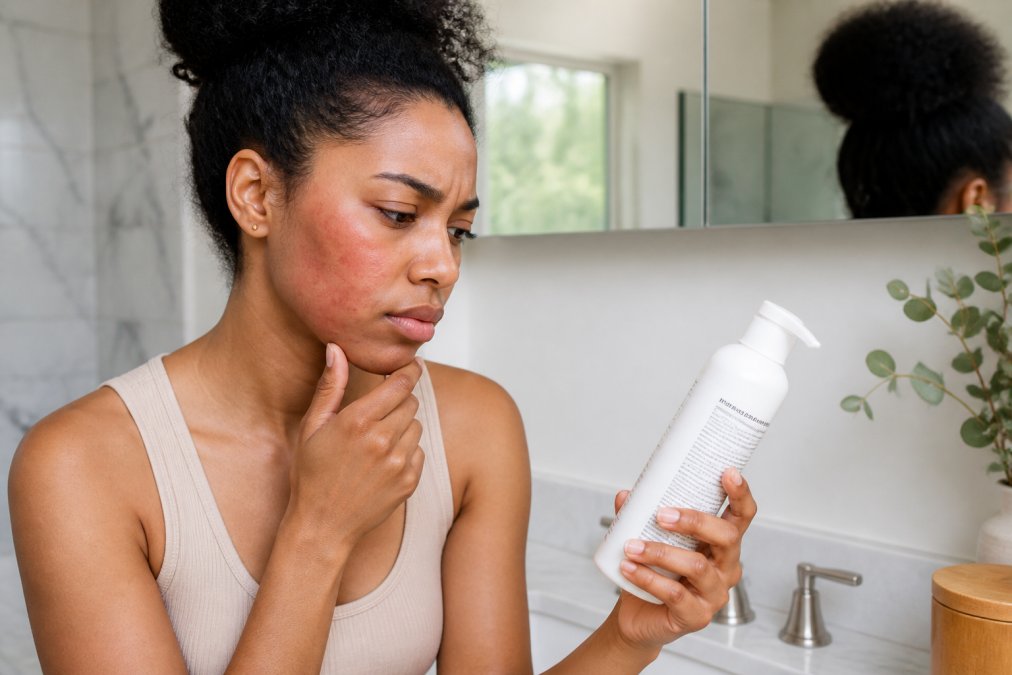
The Hidden Risk of Cross-Reactivity
Cross-reactivity is what makes botanical allergies so frustrating to pin down. If your immune system reacts to one plant compound, it may react to chemically similar compounds in unrelated plants. Someone sensitized to a Compositae plant like chamomile may later react to feverfew or echinacea, even though they never used those products before.
This is why a "new" reaction can appear to a product you've used for years. The trigger may not be the new product at all. It may be a familiar botanical your skin has finally learned to fight.
The 'Clean' vs. 'Preserved' Paradox: Why Fewer Preservatives Create More Problems
Removing preservatives doesn't make a formula gentler. It makes it more vulnerable. The reason comes down to water activity, the amount of free water in a formula that microorganisms can actually use to grow. Any product with a water base (creams, lotions, serums, micellar waters) has high water activity unless something is added to suppress it. That 'something' is a preservative system.
When a brand strips out broad-spectrum preservatives and replaces them with essential oils or nothing at all, the formula becomes a hospitable environment for bacteria, yeast, and mold. This isn't a theoretical concern.
Here's the trade-off most clean beauty marketing skips over:
Chamomile Face & Eye Primer for →
| Formulation Choice | Consumer Perception | Actual Skin Risk |
|---|---|---|
| Fewer preservatives | "Cleaner," gentler | Higher risk of microbial contamination |
| Broad-spectrum preservatives | "Chemical," harsh | Product stays stable and safe over its shelf-life |
| Essential oils as preservatives | "Natural" preservation | Weak antimicrobial action, plus sensitization risk |
| Parabens | Widely avoided | Effective, well-studied, low sensitization rate |
| Anhydrous formulas (no water) | Often labeled "preservative-free" | Lower microbial risk, but can still oxidize and irritate |
The practical takeaway: a well-preserved formula with a short, transparent ingredient list is usually safer for reactive skin than an unpreserved "clean" product. Preservation is not the enemy of sensitive skin, contamination is.

The Fragrance Factor: Essential Oils and Sensitization
Fragrance, including fragrance from essential oils, is one of the most frequent causes of allergic contact dermatitis from cosmetics. "Fragrance-free" and "unscented" are not interchangeable, either. An unscented product may contain masking fragrance to neutralize the smell of raw materials, while a fragrance-free product should contain no added fragrance at all.
How to Patch Test Skincare Products to Prevent Irritation
A proper patch test takes 3 to 5 days and involves applying a small amount of product to a controlled area, then watching for a delayed reaction. Most people skip this step because they test on their face, see nothing within an hour, and assume they're in the clear. Contact allergy doesn't work that way.
Step-by-Step Patch Testing Protocol
- Choose your test site. Apply to the inner forearm or behind the ear, not your face.
- Cleanse and dry the area. No moisturizer, no other products on that patch.
- Apply a small amount. About the size of a pea, covering a coin-sized area.
- Leave it undisturbed for 24 hours. Don't wash the area or cover it with makeup.
- Check at 24, 48, and 72 hours. Photograph the site each time so you can compare.
- Watch for delayed signs. Redness, itching, bumps, or swelling can appear on day three.
- Test one product at a time. Testing multiple products at once makes the culprit impossible to identify.
Stop the test and discontinue the product if you see a reaction at any checkpoint. If you've reacted to multiple "clean" products, a dermatological assessment, including patch testing with a trained provider, can identify the specific allergen.
Safe Makeup Brands for Sensitive Skin: What to Look For
The safest makeup for sensitive skin is formulated with a short, transparent ingredient list, avoids known fragrance allergens, and is preserved with a well-studied system rather than an essential oil blend. Ingredient transparency matters more than any single claim on the front of the package.
Look for these markers:
- Full ingredient disclosure, including fragrance components like limonene and linalool
- Fragrance-free rather than unscented if you've reacted to scent before
- A real preservation system in water-based formulas
- Patch test guidance on the label or website
- Shades and formulas tested on a range of skin tones, since irritation and pigmentation concerns often overlap
Post-Irritation Recovery: Restoring Your Skin Barrier
- Cleanse with lukewarm water and a mild, non-foaming cleanser, hot water strips lipids
- Apply moisturizer while skin is still damp to lock in hydration
- Look for barrier-supporting ingredients like ceramides, cholesterol, and fatty acids in a simple base
- Avoid occlusive balms if the skin is weeping or blistered; they can trap bacteria
- Resist scratching, which can break the skin and invite infection
- Use a mineral sunscreen daily, UV exposure slows barrier repair
If the reaction spreads, blisters, oozes, or doesn't improve within two weeks, see a dermatologist. Persistent or severe contact dermatitis sometimes needs prescription treatment, and identifying the allergen through professional patch testing prevents the next reaction. A dermatologist can also rule out other conditions that mimic contact dermatitis, such as rosacea or perioral dermatitis.
Frequently Asked Questions
Why is my skincare suddenly irritating my skin?
Sudden irritation often comes from sensitization, where repeated exposure to an ingredient triggers an immune response over time. Botanical extracts, essential oils, and preservatives like formaldehyde-releasing agents are common culprits. Even products you have used for months can cause allergic contact dermatitis once your skin becomes sensitized. If you notice redness, itching, or bumps, stop using the product and patch test any new items on a small area before applying to your face.
Is clean beauty actually safer for sensitive skin?
Not necessarily. Clean beauty lacks a standardized definition, and many natural ingredients, such as essential oils, botanical extracts, and fragrances, are known irritants. Without preservatives, products can also harbor bacteria that cause infections. For sensitive skin, look for fragrance-free, hypoallergenic formulas with a short ingredient list and proven preservatives. Brands like LUV + CO. formulate specifically for melanated sensitive skin, using non-toxic ingredients that are tested for safety and stability.
How can I tell if a product is causing an allergic reaction?
Signs of an allergic reaction include redness, swelling, itching, burning, or a rash that appears within hours to days after application. Unlike irritation, which stays at the contact site, allergic contact dermatitis can spread. If you suspect a reaction, stop using the product immediately and consult a dermatologist. Patch testing before full application is the best way to identify sensitivities. Apply a small amount to your inner forearm and wait 48 hours to see if a reaction occurs.
What are the most common skin-irritating ingredients in natural products?
Common botanical allergens include essential oils like lavender, citrus, and peppermint; preservatives such as methylisothiazolinone; and natural fragrances like limonene and linalool. Even plant extracts like chamomile and calendula can trigger reactions in some people. Cross-reactivity is also possible, where sensitivity to one botanical leads to reactions to related plants. Always check labels for these ingredients and patch test new products, especially if you have a history of skin sensitivity.