
Table of Contents
- What Dye-Free Lipstick Actually Means on an Ingredient Label
- How to Use a Lipstick Ingredient Checker Before You Buy
- Lipstick Without Red Dye: What Replaces FD&C Colors
- Lipstick for Sensitive Lips: Ingredients That Soothe Instead of Irritate
- Dye-Free Lip Color: Shade Range, Payoff, and Wear
- Comparing Dye-Free Lip Products: What to Weigh
- Conclusion: Finding Your Dye-Free Shade
- Frequently Asked Questions
Last Updated: October 12, 2026
What Dye-Free Lipstick Actually Means on an Ingredient Label
Dye-free lipstick is lip color formulated without synthetic colorants, FD&C dyes, D&C dyes, and lakes, so the shade comes from mineral pigments instead.
"Dye-free" isn't regulated the way "organic" is under USDA rules.
The practical test: read the ingredient list, not the front of the package. "Red 6," "Red 7," "Yellow 5," "Blue 1," or "CI" plus a number means a synthetic colorant, regardless of the marketing.
Synthetic Dyes vs. Mineral Pigments
Synthetic dyes are lab-made colorants, and they're identified on labels by FD&C or D&C designations plus a number.
The difference matters for two reasons. Iron oxides come in red, black, and yellow versions that blend into an enormous shade range without a single synthetic dye.
A sheer, dye-based formula can look vivid in a swatch photo and nearly invisible on deeper lip tones. A high-pigment mineral formula does the opposite.
How to Use a Lipstick Ingredient Checker Before You Buy
A lipstick ingredient checker is any tool or method that scans a product's ingredient list for colorants, irritants, and allergens before you spend money. The most reliable version is your own eyes on the printed list, cross-referenced against a database like the Environmental Working Group's Skin Deep database.
Here's how we tell customers to run a check in under two minutes:
- Open the product page and find the full ingredient list. If a brand won't publish it, that's your answer.
- Search for "FD&C," "D&C," "Red," "Yellow," "Blue," or "CI" plus a number.
- Look for carmine or cochineal extract if you want to avoid animal-derived color.
- Check the last five ingredients, where preservatives and fragrance usually hide.
- Compare the formula against a clean-beauty standard you trust.
The Label Terms That Actually Tell You Something
Labels use four naming systems for colorants:
- FD&C and D&C dyes, Certified synthetic colorants, shown as a color name plus a number, like "FD&C Red 40" or "D&C Red 6." Either prefix means the product is not dye-free.
- Lakes, A synthetic dye bonded to an insoluble base so it disperses in oil or wax instead of water. Still synthetic. On a label: "Red 7 Lake," "Yellow 5 Lake," or a CI number.
- CI numbers, "CI" stands for Color Index. The trap: CI numbers cover both synthetic dyes and mineral pigments. CI 15850 is a synthetic red lake; CI 77491 is red iron oxide, a mineral pigment. The number alone doesn't tell you which category you're in.
Reading the First Five Ingredients
The first five ingredients are listed in descending order by weight, so they tell you what the product mostly is.
If the first five are petrolatum, mineral oil, synthetic wax, and a dye, the "nourishing" claim is doing heavy lifting. Colorants legally count as "may contain" ingredients, so they often appear at the very end, normal placement, not a red flag on its own.
Why "Natural," "Organic," and "Clean" Don't Mean Dye-Free
None of these three words guarantees the absence of synthetic color:
- "Natural" has no enforceable definition for cosmetics. A naturally derived ingredient can still be chemically identical to a synthetic one.
- "Organic" is regulated by the USDA only with the USDA Organic seal and certification threshold. "Made with organic ingredients" may contain a small organic percentage and still carry a synthetic dye.
- "Clean" is a marketing term with no legal definition. Retailer standards vary, some exclude synthetic dyes, some don't.
The only reliable signal is the ingredient list. If the colorants are iron oxides, mica, and titanium dioxide, with no FD&C, D&C, lake, or CI dye code, the product is dye-free regardless of the front of the box.
Lipstick Without Red Dye: What Replaces FD&C Colors
Lipstick without red dye gets its red from iron oxides, mica, and titanium dioxide rather than Red 6, Red 7, or Red 27 lakes.
A true red built on red iron oxide reads differently than one built on a dye: more depth, less flat candy-like brightness.
The trade-off is real: mineral reds are harder to formulate in very bright, saturated tones, which is why some dye-free reds lean brick or wine rather than fire-engine.
Lipstick for Sensitive Lips: Ingredients That Soothe Instead of Irritate
Lipstick for sensitive lips should prioritize barrier-supporting butters and oils, avoid synthetic dyes and heavy fragrance, and skip drying alcohols. The goal is color that conditions while it covers.
Our Non-Toxic Moisturizing Lipstick is 80% organic and 98% natural, built on castor seed oil, shea butter, cocoa seed butter, jojoba, and coconut oil, with vitamin E and botanical extracts.

A few ingredients worth learning by name if your lips react easily:
Non-Toxic Moisturizing Lipstick - Natural Pigments →
- Castor seed oil: gives lipstick its glide and helps seal in moisture
- Shea and cocoa butters: soften and cushion dry, chapped lips
- Sunflower seed wax and candelilla wax: plant-based structure without synthetic wax
"Fragrance" can represent dozens of undisclosed compounds and is a frequent culprit in lip reactions. A naturally vanilla-flavored formula is a safer bet for reactive lips.
Dye-Free Lip Color: Shade Range, Payoff, and Wear
Dye-free lip color now spans nearly the full spectrum: nudes, browns, berries, wines, and true reds, all built from mineral pigments. The old assumption that clean color means limited color is out of date.
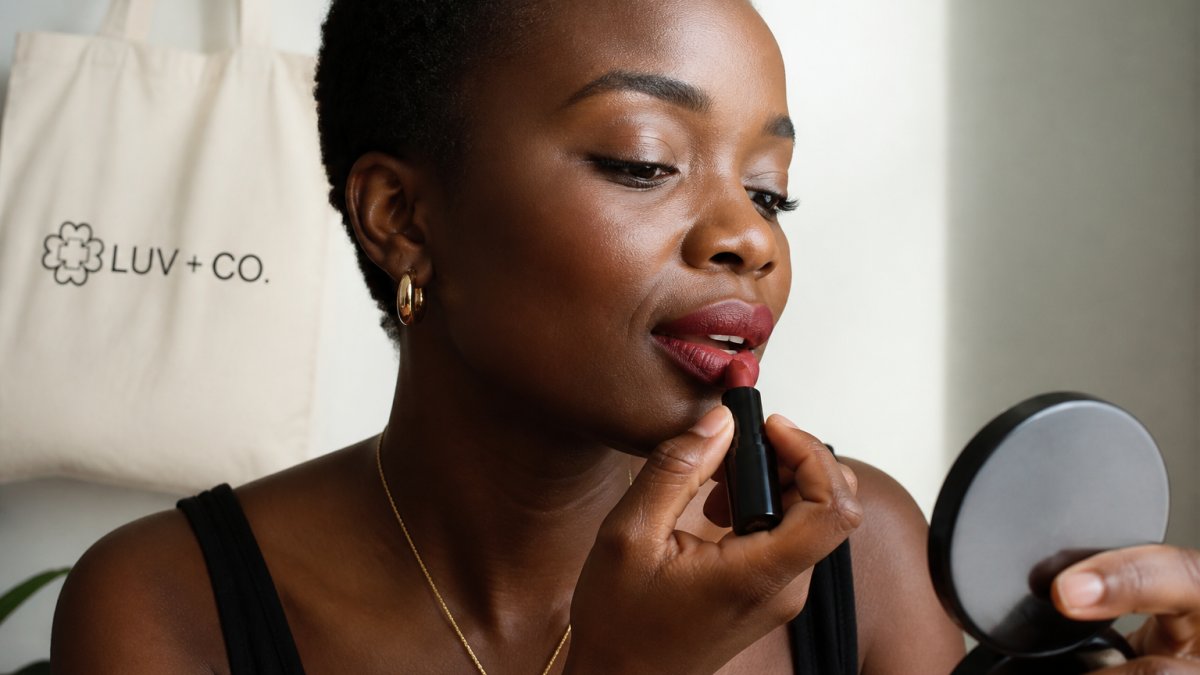
Payoff is where pigment ratio does the work. Our Moisturizing Lipstick uses a deliberately high pigment load so shades stay visible on naturally deeper lips instead of turning sheer or chalky. Our Luvee Duvee Lip Crayons apply the same principle in a twist-up format that doubles as liner and lipstick, and our Hydrating Lip Duo pairs a lipstick with a complementary gloss topper for testing shades.

Buildable Color and Finish Options
Finish is a separate decision from color. A creamy satin finish reads softer and more natural; a matte reads bolder but demands more lip prep. Dye-free formulas tend to sit in the satin-to-creamy range because mineral pigments need emollient to spread evenly.
For buildable color, apply one pass for a wash of tint and two or three for full opacity. Layering a gloss over a matte-leaning lipstick gives you shine without changing the base shade.
Comparing Dye-Free Lip Products: What to Weigh
Most dye-free lipstick roundups compare products on vibes: a swatch photo, a sentence about how creamy it feels, a verdict. That tells you almost nothing about whether a formula will work on your lips. A useful comparison runs every product through the same measurable criteria.
Here are the criteria worth tracking:
| Criterion | How to Measure It | What Good Looks Like |
|---|---|---|
| Colorant type | Read the full ingredient list, including "may contain" | Iron oxides, mica, titanium dioxide; no FD&C, D&C, lake, or CI dye codes |
| Pigment load | Number of passes needed for full opacity | Full coverage in one to two passes |
| Base ingredients | Position of oils and butters in the list | Castor oil, shea, cocoa butter, jojoba near the top |
| Finish | How the formula reads on the lip, not the swatch | Creamy, satin, or buildable matte |
| Wear time | Hours before noticeable fade, tracked over a normal day | Consistent color through eating and drinking |
| Transfer | Press a tissue to your lips after application | Minimal color lift on the tissue |
| Hydration | How lips feel at hour four versus before application | Comfortable, not tight or flaky |
| Shade count | Number of shades offered in the line | Enough range to match your undertone |
| Ingredient transparency | Is the full list published on the product page? | Complete list, including "may contain" colorants |
| Claims | Vegan, cruelty-free, paraben-free, talc-free | Matches your values and skin needs |
How to Run a Fair Comparison at Home
You don't need a lab to compare two dye-free lipsticks honestly. You need a consistent method:
- Start from the same baseline. Apply each product to bare lips on a different day, same time of day, no balm underneath, balm changes how pigment sits.
- Count your passes. Note how many swipes it takes to reach the opacity you'd actually wear.
- Time the wear. Check in at two hours and again at four, noting whether color faded evenly or wore off in the center first.
- Test transfer the same way each time. Press a tissue to your lips with the same light pressure and compare how much color lifts.
- Judge hydration by feel, not by claim. The question is whether your lips feel comfortable at hour four.
The Trade-Offs Nobody Puts in the Table
A comparison is only useful if it names the downsides, and dye-free formulas have real ones:
- Saturated brights are harder to build. Mineral pigments can hit a true red, but the brightest, most neon-leaning tones are easier with synthetic dyes. A dye-free red often leans brick, wine, or berry rather than fire-engine.
- Pigment load affects comfort. A higher pigment ratio gives better coverage but can feel drier without enough emollient. The best dye-free formulas pair a high pigment load with a rich oil and butter base.
- Finish range is narrower. Mineral pigments need emollient to spread evenly, so dye-free formulas cluster in the satin-to-creamy range. A true matte is possible but usually requires more lip prep.
That's why we built our shade-matching around Melanin Analysis rather than standard color analysis, which was never designed for deeper lip tones. If you can't test in person, our mini collections let you try shades at home before committing to a full size.
A Note on Price
Price is the least useful filter on its own, because a cheap tube and an expensive one can share the same colorant system. What price should reflect is the pigment ratio and ingredient load, a formula built on organic oils and a high mineral pigment ratio costs more to make than one built on petrolatum and a lake dye. Compare price per ounce across products, and weigh it against the criteria above rather than in place of them.
Conclusion: Finding Your Dye-Free Shade
The hardest part of going dye-free isn't finding a formula, it's trusting the color will actually show up on your lips. That doubt is earned: too many "clean" lipsticks swatch beautifully and disappear on deeper pigment.
LUV + CO. exists to close that gap. Our Non-Toxic Moisturizing Lipstick delivers full-coverage mineral color with 80% organic ingredients, our Luvee Duvee Lip Crayons give you liner and lipstick in one creamy pass, and our Hydrating Lip Duo lets you test a shade with a complementary gloss before you commit.

Find your shade and stop choosing between healthy lips and color you love.
Frequently Asked Questions
What does dye-free mean on a lipstick label?
Dye-free means the formula contains no synthetic colorants, including FD&C dyes, lake dyes, or carmine. Instead, color comes from mineral pigments like mica, titanium dioxide, and iron oxides. On an ingredient list, look for these minerals rather than names like Red 6, Red 7, or Blue 1 Lake. A dye-free lipstick may still deliver full color; it simply achieves it without artificial dyes.
How can I check whether a lipstick contains red dye?
Turn the tube over and scan the ingredient list for terms like Red 6, Red 7, Red 27, or Red 40 Lake. These are synthetic dyes. If you see mica, titanium dioxide, or iron oxides instead, the color likely comes from minerals. A lipstick ingredient checker app or a quick search of unfamiliar names can confirm. When in doubt, contact the brand directly and ask for a dye-free confirmation.
Can lipstick be made without synthetic dyes?
Yes. Many brands now use mineral pigments such as mica, titanium dioxide, and iron oxides to create rich, buildable color without synthetic dyes. These minerals can produce a full shade range, from nudes to deep reds, and are often paired with nourishing oils and butters for a creamy texture. The result is a dye-free lip color that still delivers visible payoff on melanated lips.
What ingredients provide color in dye-free lipstick?
Mineral pigments do the work. Mica adds shimmer and depth, titanium dioxide provides opacity and brightness, and iron oxides create reds, browns, and yellows. These minerals are blended to achieve specific shades without synthetic dyes. Formulations may also include castor seed oil, shea butter, and vitamin E to condition lips while the pigments deliver color.