

Table of Contents
- Why Traditional Color Analysis Fails: The Core Problems
- Common Seasonal Color Analysis Mistakes
- Why Color Analysis Analysts Disagree So Often
- Color Analysis for Melanated Skin: Where It Breaks Down
- How to Find Colors That Suit Your Skin Tone Without a Season Label
- A Practical Troubleshooting Method for Results That Feel Wrong
- Conclusion: Adapting Your Palette to Real Life
- Frequently Asked Questions
Last Updated: October 7, 2026
Why Traditional Color Analysis Fails: The Core Problems
Color analysis fails when it treats a season label as a fixed answer instead of a starting point. At LUV + CO., we see this constantly: someone gets typed as a "Winter" or "Autumn," buys a whole wardrobe around it, and still feels like the colors are fighting her skin. The problem isn't her. It's the system.
Here's why traditional color analysis fails so often for melanated skin. Most of these methods were built decades ago, using a narrow set of faces and a simple four-season grid. That grid doesn't account for the depth, undertone, and contrast that show up in deeper complexions.
The Four-Season System's Origins and Limits
The four-season system sorts everyone into Spring, Summer, Autumn, or Winter. It's built on two ideas: whether your undertone runs warm or cool, and how light or deep your coloring is.
That's it. Two variables for millions of faces.
The twelve-season system and sixteen-season system added more categories, which helps. But they still lean on the same core assumptions. If the base framework wasn't built for deep skin, adding more boxes doesn't fix the foundation.
Common Seasonal Color Analysis Mistakes
Most seasonal color analysis mistakes happen before any draping even starts. The result depends on the conditions, the analyst, and the day.
Here's what goes wrong most often:
- Testing under warm or yellow artificial lighting
- Using fabric swatches that don't match real clothing textures
- Rushing the draping process in under 15 minutes
- Ignoring how makeup and hair color change the reading
- Letting personal color preferences sway the call
Each one shifts the outcome. Stack a few together, and you get a season that doesn't hold up in daylight.
Lighting and Testing Conditions That Skew Results
Natural light is the only reliable testing condition. Artificial lighting adds a color cast that changes how your skin reads.
Warm bulbs push everyone toward warm. Cool bulbs push everyone toward cool. Neither is telling you the truth about your undertone.
If your analysis happened in a room with mixed lighting, or under a ring light, treat the result as a rough guess. The fix is simple: retest near a window, mid-morning, with no makeup.
Why Color Analysis Analysts Disagree So Often
Two trained analysts can look at the same face and reach different conclusions. That's not a rare glitch. It's built into the method.
Color analysis relies on subjective interpretation. There's no lab test, no measurement, no objective score. The analyst's eye, training, and even their own coloring influence the call. Two analysts with different reference points will read the same undertone differently, and both can be sincere.
What the Evidence Actually Supports (and What It Doesn't)
This is where most articles stop, and where the honest answer is more useful.
Color perception itself is well established. Human vision adapts to surrounding light, which is why the same fabric can look warm in one room and cool in another. Contrast effects are real, a color looks different depending on what sits next to it. These are principles of visual perception, and they're not in dispute.
What's much weaker is the leap from those principles to fixed seasonal categories. There's no widely accepted, peer-reviewed standard that assigns a person to a season and predicts which specific colors will flatter them. The categories are a practical convention, not a measured classification. That distinction matters, because it explains why two analysts can disagree without either being incompetent, they're applying a convention, not reading a measurement.
How to Tell Normal Disagreement From a Red Flag
Some disagreement is expected. Some signals a method problem.
- Normal: Two analysts agree you're cool-toned but split on whether you're a Summer or a Winter. The underlying trait is consistent; only the label differs.
- Normal: One analyst flags that your result might shift if you change your hair color. That's an honest caveat, not a failure.
- Red flag: Two analysts disagree on whether your undertone is warm or cool at all. That means the reading isn't stable, and the label built on top of it won't be either.
- Red flag: An analyst won't explain which trait drove the call, or dismisses your own observation that a color looks wrong on you.
When the disagreement is about the label, you can still work from the traits. When it's about the traits themselves, the analysis hasn't produced a reliable result, and no season name will fix that.
Why This Matters for Your Wallet and Your Wardrobe
If you've already bought around a season label and it feels off, the disagreement problem is your explanation. You weren't misjudged by one bad analyst. You were handed a convention that two trained people can apply differently. That's a reason to test colors directly on your own skin, in your own light, before you commit to a palette, not a reason to distrust your own eyes. Refining your selection through personal observation ensures that every piece in your wardrobe color palette harmonizes with your unique undertones rather than adhering to a rigid, external classification.
Melanin Analysis Appointment →
Color Analysis for Melanated Skin: Where It Breaks Down
Color analysis for melanated skin breaks down because the systems weren't designed with deep complexions in mind. The categories assume a narrower range of depth, undertone, and contrast than melanated skin actually shows.
This is the core issue. It's not that the analysis is mean or careless. It's that the framework is incomplete.
Undertone, Depth, and the Gray Cast Problem
Deeper skin holds more melanin, which changes how light reflects off the surface. That reflection affects value, chroma, and contrast all at once.
When a foundation or fabric is matched to the wrong undertone, you get the gray cast. The color looks flat, ashy, or slightly dead against your skin. It's the opposite of color harmony.
The real fix isn't a new season label. It's matching to your actual undertone, depth, and contrast directly.
How to Find Colors That Suit Your Skin Tone Without a Season Label
You can find colors that suit your skin tone without ever accepting a season label. Skip the category and test the colors themselves.
A controlled, repeatable method works better than a one-time verdict:
- Set the light. Stand near a window, mid-morning, facing the light.
- Go bare. Remove makeup and pull hair back.
- Gather swatches. Pick fabrics in warm, cool, and neutral tones.
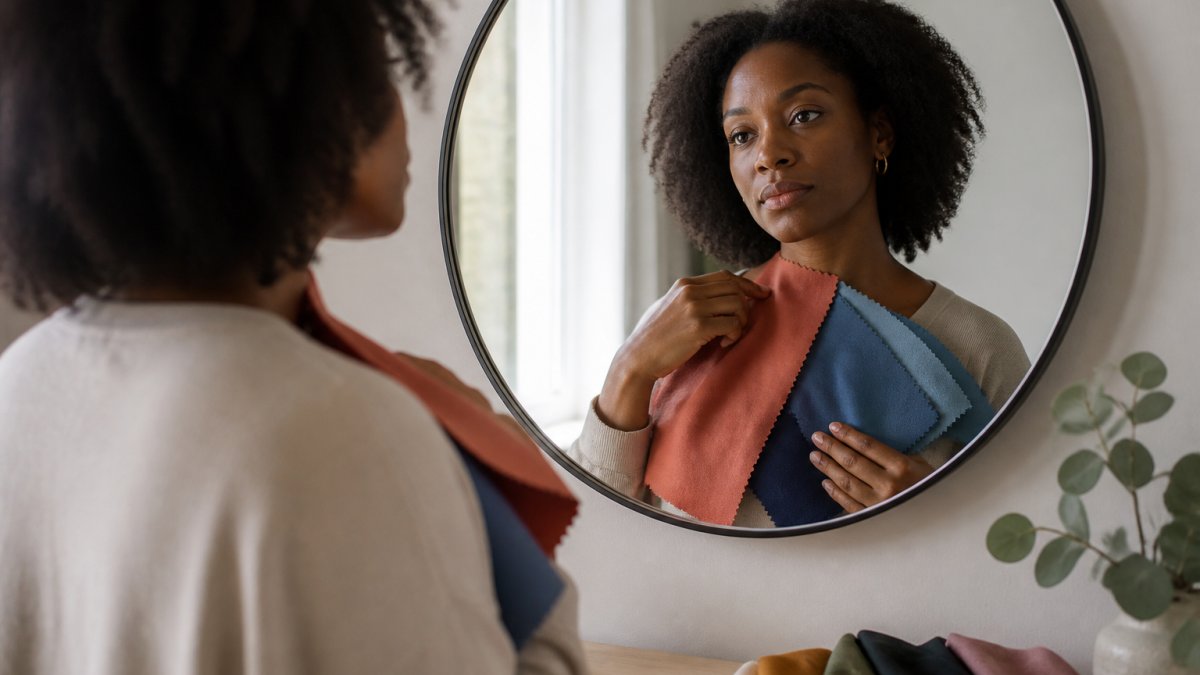
- Drape one at a time. Hold each under your chin, one at a time.
- Watch your face, not the fabric. Look for shadows, gray cast, or brightness.
- Note the winners. Keep the colors that make your skin look even and awake.
- Repeat on a different day. If the same colors win twice, you've got your palette.
This gives you a personal color palette built on your real skin, not a rigid category.
| What You Notice | What It Means | What to Do |
|---|---|---|
| Skin looks even and bright | Color works with your undertone | Keep it in your palette |
| Gray or ashy cast appears | Wrong undertone for you | Skip or adjust the shade |
| Shadows deepen under eyes | Color is too cool or too dark | Try a warmer or lighter tone |
| Face looks washed out | Color is too light or low-contrast | Go deeper or more saturated |
A Practical Troubleshooting Method for Results That Feel Wrong
When a result feels wrong, don't throw out the whole idea. Work through it step by step.
Here's a simple troubleshooting flow:
- Did you test in natural light? If not, retest. This fixes most problems.
- Were you wearing makeup or colored hair? Retest bare-faced.
- Did the analyst rush? Book a slower session or retest at home.
- Does the label match your actual undertone? Check warm, cool, and neutral directly.
- Still off? Drop the label and build a palette from tested colors.
Most "wrong" results come down to testing conditions, not your skin.
Conclusion: Adapting Your Palette to Real Life
A season label is a tool, not a rule. The real goal is a palette that works with your wardrobe, your budget, and your personal style.
Adapt it as your hair color, makeup, and preferences change. The colors that flatter you today may shift over time, and that's normal.
At LUV + CO., we built our Melanin Analysis shade matching system for exactly this reason. Our clean, talc-free formulas are made for melanated, sensitive skin, and our mini collections let you test shades safely at home. If you're near our McDonough studio, you can book a 15-minute foundation shade match or a full Melanin Analysis appointment.

Find your shade with LUV + CO. and skip the season label entirely.
Frequently Asked Questions
Why does seasonal color analysis not work for everyone?
Seasonal color analysis was built around a four-season framework that assumes most people fit neatly into warm, cool, light, or deep categories. In practice, many people, especially those with melanated skin, have undertones and contrast levels that do not map cleanly onto those boxes. Testing conditions like artificial lighting, makeup, and hair color can also shift results. When the system forces a match that is not there, the recommended palette can feel wrong or unflattering.
Why do color analysts disagree about someone's season?
Analysts disagree because color analysis relies on subjective visual judgment. Two trained analysts can look at the same person under different lighting, use different draping fabrics, or weigh undertone versus contrast differently and arrive at opposite conclusions. There is no standardized certification or measurement tool that produces one correct answer. This disagreement is a sign that the system has limits, not that one analyst is necessarily wrong.
Can your skin tone change your color analysis results?
Yes. Skin tone can shift with sun exposure, hormonal changes, and conditions like hyperpigmentation or acne that alter surface color. Makeup and hair color also change how your overall coloring reads to an analyst. If you were analyzed while wearing foundation or after a significant change in your skin, the result may no longer reflect your current coloring. Retesting under controlled conditions can give a more accurate picture.
What should you do if your color palette does not suit you?
Start by retesting under neutral natural light with no makeup, using fabric swatches in a range of temperatures and depths. Pay attention to how your skin reacts, whether it looks even and bright or gray and washed out, rather than whether a swatch matches a season. If a palette still feels wrong, treat it as a starting point rather than a rule. Adapt colors to your wardrobe, budget, and personal taste, and focus on the shades that make your complexion look healthiest.