

Table of Contents
- Why Online Foundation Shade Matching Fails (and How to Fix It)
- How to Determine Skin Undertone Before You Shop
- Step 1: Assess Your Skin Tone Depth and Finish Preference
- Step 2: Use Foundation Shade Matching Tools the Right Way
- Step 3: Swatch Test at Home and Read the Color in Natural Light
- Understanding Formula, Oxidation, and Coverage for the Best Foundation for Hyperpigmentation
- Troubleshooting a Mismatched Shade
- Conclusion: Shop With a Shade-Matching Strategy
- Frequently Asked Questions
Last Updated: September 6, 2026
Finding your exact foundation shade online is one of the hardest parts of shopping for makeup, especially for melanated skin where mainstream shade ranges often miss the mark. The core problem is that a screen cannot show you how a pigment will interact with your unique complexion, so you need a strategy that combines color theory with practical testing. This guide breaks down a step-by-step method for shade matching that accounts for undertone, depth, and formula, so you can buy with confidence. We will show you how to use digital tools correctly, verify your match at home, and avoid the common pitfalls like oxidation and mismatched lighting that lead to wasted money.

Why Online Foundation Shade Matching Fails (and How to Fix It)
Online shade matching fails most often because a camera and screen compress the color spectrum, stripping away the subtle variations that separate an exact match from a close one. A photo taken in warm indoor light casts golden tones across your skin, and a screen's color calibration shifts how that image appears to your eye. Add in oxidation once the foundation meets your skin's natural oils, and you have a shade that looks correct in the listing but wrong on your face.
The fix is to treat the digital tool as a starting point, narrowing your options from fifty shades down to three or four neighbors within one depth range. The real decision happens when you test those finalists on your skin, in natural light, and observe how the formula wears over a few hours.
How to Determine Skin Undertone Before You Shop
Your undertone is the subtle color beneath your skin's surface, and it is the single most important factor in finding a foundation that does not look ashy or orange. Skin tone is the depth of your complexion, while undertone is the hue that sits underneath it, they are entirely separate qualities. For melanated skin, undertones commonly fall into cool, warm, neutral, and olive categories, and getting this wrong is why many Black women end up with a gray cast or an overly red finish.
The Vein Test, the Jewelry Test, and the White Paper Test
Three simple tests can reveal your undertone without any special equipment. Look at the veins on the inside of your wrist in natural light: blue or purple suggests cool, green suggests warm, and a mix suggests neutral. Hold gold and silver jewelry against your bare arm and notice which metal makes your skin look brighter: gold flatters warm and olive undertones, silver suits cool, and neutral can wear both. Finally, hold a plain white sheet of paper next to your face: cool undertones show pink or rosy tones, warm show golden or yellow, and olive reveals a slight green tint.
Step 1: Assess Your Skin Tone Depth and Finish Preference
Before you open any shade finder tool, identify where your skin tone falls on the depth scale, typically labeled as fair, light, medium, tan, deep, or rich. This narrows the field dramatically, because most brands organize shade ranges by depth first and undertone second. If you already own a foundation that is close, check its label for a depth descriptor and use that as your anchor.
Your finish preference matters just as much as the color. A matte finish can appear flat and ashy on dry or textured skin, while a dewy finish can emphasize oiliness in the T-zone. For sensitive, melanated skin prone to hyperpigmentation, a satin or natural finish with buildable coverage is often the most forgiving, since it lets you layer pigment only where you need it (the American Academy of Dermatology).
Step 2: Use Foundation Shade Matching Tools the Right Way
Foundation shade matching tools are most effective when you treat them as a filter, not a verdict. These tools use algorithms to estimate your depth and undertone, but they cannot account for how a specific formula will sit on your skin. The best tool lets you compare multiple adjacent shades rather than locking you into a single recommendation. Use it to identify your depth range, then order samples of two or three neighboring shades within that range.
How to Use a Photo-Based Shade Finder
Photo-based shade finders require specific conditions to give usable results. Take your photo in natural daylight, standing facing a window so the light is even across your face. Remove any foundation or tinted moisturizer first, and pull your hair back so your jawline and neck are visible. Avoid a front-facing camera with a beauty filter, since these smooth out the pigmentation variations the tool needs to read.
How to Evaluate a Tool's Recommendation
Before you trust any shade finder result, run it through three checks. First, does the tool ask about your undertone separately from your depth? If it only asks for a photo or a single "skin tone" question, it is likely conflating the two, a common source of error for melanated skin. Second, does it show the shades it is choosing between, or only give one answer? A range of adjacent shades is more useful because it acknowledges the imprecision of digital matching. Third, does the recommendation align with the brand's own shade description? If the tool says "rich with neutral undertones" but the shade name includes "golden" or "peach," the algorithm has likely misread your undertone.
When Tools Disagree
If two different brand tools give different depth or undertone readings, do not assume one is broken. The tools are calibrated to each brand's specific shade range, so a shade named "Tan" at one brand may sit at a different depth than "Tan" at another. The more useful comparison is the undertone reading: if both say you are warm, you are almost certainly warm. If they disagree, one says warm, one says neutral, your skin likely sits on the border, so test shades from both categories.
How to Read Shade Names and Codes
Most brands encode useful information in shade names, and learning to decode them saves you from ordering blind. A typical convention is [Depth] + [Undertone]: "Golden Beige" means light-medium depth with warm undertones; "Caramel" usually indicates medium-tan depth with neutral-to-warm undertones; "Espresso" signals a deep shade, but the undertone varies by brand (peer-reviewed research). In numeric systems, the first digit often indicates depth (1 is lightest, 10 is deepest) and the letter indicates undertone (C for cool, N for neutral, W for warm, O for olive). Words like "rosy," "peach," or "pink" mean cool; "golden," "honey," or "amber" signal warm; "beige" or "sand" usually means neutral.
The Gap Most Tools Miss: Formula Behavior
No shade finder, photo-based, quiz-based, or AI-driven, can tell you how a foundation will oxidize on your skin, settle into texture, or look after four hours of wear. These are formula properties, not color properties, and they are why two people with identical skin tones can wear the same shade number in different formulas and get different results. A sheer, water-based foundation lets your natural skin tone show through, so the match needs to be closer. A full-coverage, pigment-dense foundation is more forgiving of a slight depth mismatch but less forgiving of an undertone mismatch. A matte, oil-absorbing formula can dry down darker than it applies, while a dewy, hydrating formula can lighten as it blends into moisturizer.
This is why the most reliable "tool" is not an app, it is a sample set. Many brands offer a shade matching system powered by Melanin Analysis, designed specifically for melanated skin because traditional color analysis methods were not created with deeper complexions in mind. If a brand offers sample sets, that is the safest route. LUV + CO.'s Melanin Match Foundation Sample Set includes four neighboring shades within one depth range, so you can test at home before committing to a full-size bottle.

Step 3: Swatch Test at Home and Read the Color in Natural Light
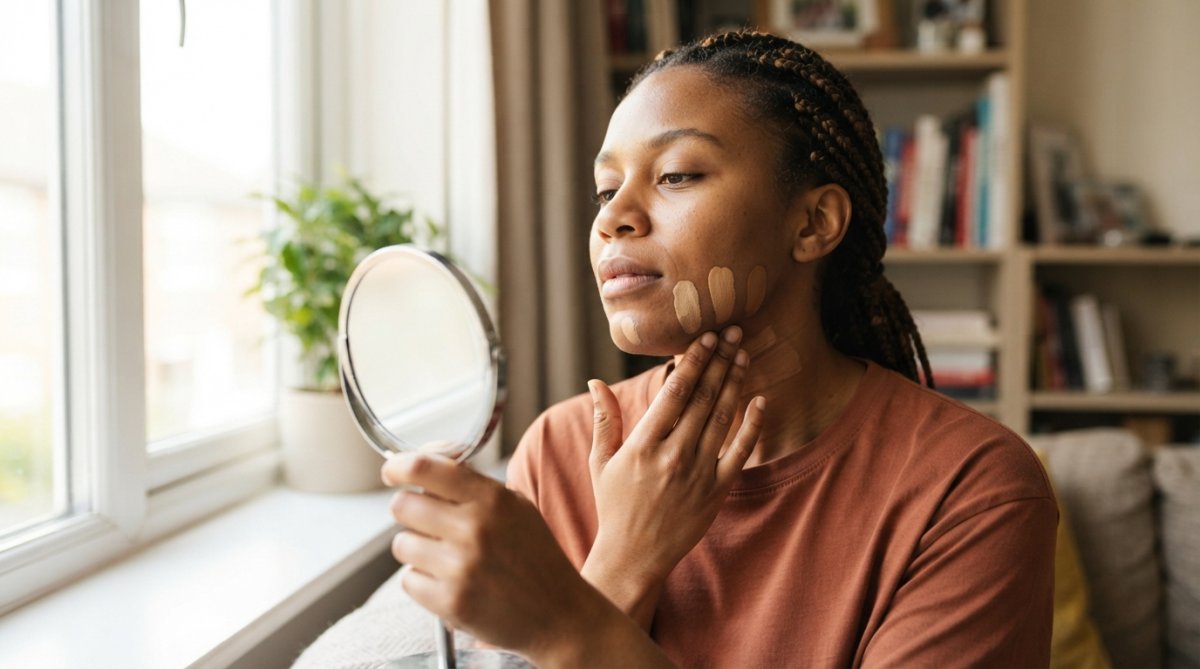
Swatch testing is the only way to verify a shade, and the jawline test is the gold standard because it connects your face to your neck. Apply a thin stripe of each sample shade along your jawline, from cheek to neck, and blend the edges slightly. Do not rub the product in fully; you want to see the color sitting on top of your skin to judge the match.
Read the results in natural daylight, ideally near a window or outside. Indoor lighting, especially fluorescent or warm LED bulbs, distorts color and can make a cool shade look neutral or a warm shade look more golden. Check the swatches in a mirror, then walk to a different room with different lighting to see how the shade holds up. A correct match should disappear into your skin, with no visible line at the jaw and no gray or orange cast.
Understanding Formula, Oxidation, and Coverage for the Best Foundation for Hyperpigmentation
The best foundation for hyperpigmentation is not just about the correct shade; it is about a formula that provides enough coverage without irritating the skin. Hyperpigmentation and acne scars require a buildable medium-to-full coverage foundation that can be layered precisely on affected areas, rather than a heavy mask applied all over. A lightweight, buildable formula lets you spot-correct dark patches while keeping the rest of your complexion looking natural.
Oxidation is another variable that changes a foundation's color after application. When the pigment reacts with the air and your skin's natural oils, it can darken or turn orange over the course of an hour (peer-reviewed research). To test for oxidation, apply a swatch and wait at least five minutes before judging the color. If you have oily skin, you may notice more oxidation, so you might need a shade slightly lighter than your initial match.
For melanated, sensitive skin, the formula's ingredient list is just as important as the color. Many conventional foundations use pigments that can leave a gray cast on deeper skin tones, or contain irritating ingredients that worsen acne and hyperpigmentation. A foundation formulated with mineral pigments, like LUV + CO.'s Melanin Match Liquid Foundation, is designed to even the appearance of melanated skin without triggering sensitivity, providing medium, buildable coverage that respects skin dealing with dryness, visible hyperpigmentation, and sensitivity.
Troubleshooting a Mismatched Shade
If you followed the process and still ended up with a shade that is off, you can often fix it rather than discarding the bottle. A foundation that is too light can be warmed up by mixing in a drop of a deeper shade or a liquid bronzer. A shade that is too dark or too orange can be sheered out with a moisturizer or mixed with a lighter concealer.
When the undertone is wrong, the fix is different. A foundation with too much pink can be neutralized with a small amount of a yellow-based corrector, while one that looks too golden can be cooled down with a touch of a red or blue-based mixer. These techniques adjust the pigment's position on the color spectrum without changing the formula's finish.
For future purchases, the best defense is testing samples before buying a full-size product. Many brands offer sample sizes specifically for this purpose. LUV + CO., for example, offers foundation and concealer samples for a few dollars each, allowing you to test a shade in your own lighting and on your own skin before you invest.
Conclusion: Shop With a Shade-Matching Strategy
Buying foundation online does not have to be a gamble. By determining your undertone, narrowing your depth range, and using shade finder tools as a starting point rather than a final answer, you can confidently choose a shade that matches your skin. Swatch testing in natural light will save you from the frustration and expense of a mismatched purchase.
At LUV + CO., we understand the specific challenges of finding foundation for melanated, sensitive skin, which is why our formulas are created by a beauty product development PhD and designed to cover hyperpigmentation without irritation. Our certified non-toxic, vegan, and talc-free products are scientifically formulated to match melanated skin better, and our sample sets let you test shades safely at home. Get started with LUV + CO. and find your shade.

Frequently Asked Questions
How do I find my correct foundation shade online?
Start by determining your undertone using the vein or jewelry test. Then, use a foundation shade matching tool on a brand's website as a starting point, not the final answer. Cross-reference that result with the brand's shade descriptions. Finally, order a sample set or a few deluxe minis of neighboring shades to swatch at home in natural light before buying the full size.
Why is it harder to find foundation shades for melanated skin online?
Some shade finder tools are built on color analysis systems that may not be accurate for deeper skin tones. They can sometimes miss the red, golden, or olive undertones common in melanated skin, leading to matches that look ashy or orange. This is why understanding your undertone and testing formulas in person or with samples is critical.
What should I do if my foundation shade looks different online versus in person?
The discrepancy is usually caused by lighting and screen calibration. A shade that looks right on your phone may look different on a laptop. Before purchasing, check the shade description for specifics like 'golden undertone' or 'neutral.' Once it arrives, swatch it on your jawline and check the color in natural daylight. If it is still wrong, check the brand's return policy.
Can I find my foundation shade using a picture?
Photo-based shade finder tools can give you a helpful starting point, but they are not precise. Their accuracy depends on your camera, lighting, and the tool's analysis. For a more reliable result, use the photo match to narrow down to two or three shades, then try samples of those shades on your skin to confirm the match.
The process of finding your foundation shade online is a skill, and like any skill, it improves with the right method. You can rely on guesswork and hope, or you can use the color theory and testing techniques outlined here to shop with precision. The choice is yours, but the tools are ready when you are.