

Last Updated: October 22, 2026
Quick Summary
The best blush for melanated skin is chosen by undertone first, then saturation to match your depth, using transparent or warm-toned minerals instead of white-based powders that read gray or chalky on deep skin. Berry, plum, brick red, coral, fuchsia, and true orange are the shade families that show up, applied high on the cheekbone in thin layers.
- Warm undertones suit brick red, deep coral, warm orange, terracotta, and bronze-tinged rose.
- Olive undertones should avoid strong pink or peach bases and reach for warm brick, burnt sienna, and muted plum.
- Very deep skin needs pigment density over hue, since sheer formulas will not register in daylight or on camera.
- Apply blush high on the cheekbone and build in two or three thin passes rather than one heavy one.
- Loose mineral powder suits oily skin in hot or humid climates and holds pigment for 8+ hours.
Table of Contents
- Why Blush for Melanated Skin Needs a Different Approach
- Blush Undertones for Melanated Skin: Match Your Complexion
- Best Blush for Dark Skin: Shade Families That Show Up
- How to Apply Blush on Dark Skin for a Natural Finish
- Blush for Sensitive Skin: Formula and Ingredient Checks
- Cream, Powder, and Liquid: Choosing Your Formula
- Comparison Table: LUV + CO. Blush Options and Pricing
- Frequently Asked Questions
Why Blush for Melanated Skin Needs a Different Approach
Blush for melanated skin is not a lighter shade applied with a heavier hand. It is a separate color problem, and most mainstream shade ranges still treat it as an afterthought. Who What Wear's roundup of highly pigmented blushes for brown skin describes finding pigmented blush for darker complexions as a genuine challenge, and that matches what we hear from customers every week.
Many traditional blushes are built on white-based powders, which read gray or chalky on deep skin before the color even shows up.
At LUV + CO., we formulate every cheek color around melanin first. Below: undertones, the shade families that actually show up, and how to apply blush on dark skin so it looks like your skin, only warmer.
Blush Undertones for Melanated Skin: Match Your Complexion
Blush undertones for melanated skin come down to two variables: skin depth and underlying warmth, coolness, or green cast. Most shade charts lump melanated skin into one category and hand you a single berry, which is why so much cheek color ends up muddy, ashy, or invisible.
Start With Undertone, Then Adjust for Depth
Undertone is the hue beneath your skin's surface, separate from depth. Warm leans golden, peachy, or red; cool leans blue or violet; neutral sits between.
- Warm undertones: brick red, deep coral, warm orange, terracotta, and bronze-tinged rose
- Neutral undertones: berry, mauve, muted plum, and soft rosewood
- Cool undertones: fuchsia, true plum, blue-based berry, and cool cherry
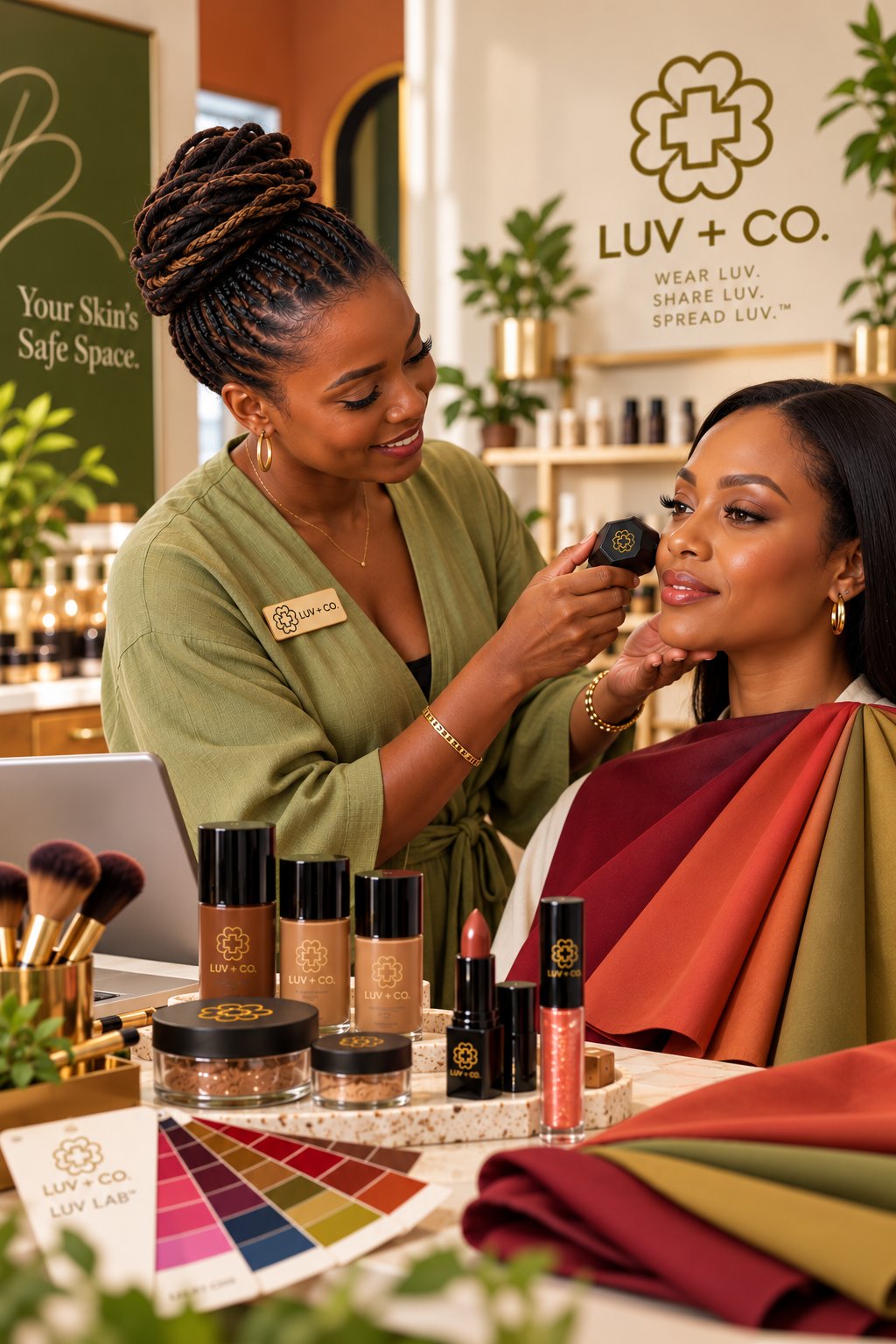
Quick check: hold a pure white cloth and a cream cloth near your jaw in daylight. White making your skin look sallow or greenish means olive; cream washing you out while white brightens means cool; both looking fine means neutral.
How Skin Depth Changes Your Shade Range
Depth decides how much saturation you need and how a shade reads once blended. The same pan can look bold on medium skin and sheer on very deep skin, so treat the chart below as a starting point, not a rule.
- Light to medium melanated skin: soft rose, muted mauve, peach-tinged coral, and dusty berry. Highly saturated shades can overwhelm this depth, so build gradually.
- Medium-deep skin: warm brick, rosewood, deep coral, and muted plum. This is the widest range, because most shade families register without turning chalky.
- Deep skin: saturated berry, true plum, brick red, fuchsia, and deep orange. Pastels and white-based pinks disappear or turn gray here.
Patrick Ta's guide to blush for darker skin tones groups rich berries, deep corals, warm brick reds, vibrant fuchsias, and plums as the shades that tend to perform best on darker complexions, which lines up with the depth mapping above.
Why White-Based Pigments Fail on Melanated Skin
Many traditional blushes use a white or chalk base to make color pop in the pan. The fix is not more product but a formula built on transparent or warm-toned minerals, so color reads as skin, not powder, the principle behind our Matte Blush Mineral Pigments, which use iron oxides and micas rather than white filler.

If your cheeks tend to flush unevenly or react to fragrance, pair your blush routine with gentle eye and lip products formulated the same way. Our Natural Lift Mascara is built for sensitive eyes, and our dye-free Non-Toxic Moisturizing Lipstick keeps the same short ingredient list.
Best Blush for Dark Skin: Shade Families That Show Up
The best blush for dark skin falls into two broad families: deep cool-toned reds and purples, and saturated warm-toned corals and oranges. Both work. They simply create different moods.
Berry, Plum, and Brick Red
Berry and plum read as a natural flush on deep skin because they echo the skin's own shadow tones. Brick red sits warmer and gives a sun-kissed effect without turning orange.
These are the safest everyday choices if you are new to bold cheek color. They build gradually and forgive a heavy hand.
Coral, Fuchsia, and Orange
Coral and fuchsia are the statement shades, and they photograph beautifully. Deep coral keeps warmth without going peachy, while fuchsia delivers a bright pop that holds its own against rich skin.
Orange is the most misunderstood of the group. A true, saturated orange flatters warm deep skin; a pale peach does not. Curly Nikki's guide to the best blushes for dark skin covers cream, liquid, and powder options across these families, which matters because formula changes how a shade reads.
How to Apply Blush on Dark Skin for a Natural Finish
To apply blush on dark skin for a natural finish, start with less product than you think you need, place color high on the cheekbone, and build in thin layers. Placement and blending matter more than the shade.
Matte Blush Mineral Pigments (Loose) →
Placement, Blending, and Layering
- Prep the skin first. Blush grabs unevenly on dry patches. Moisturize and let it settle before applying base.
- Tap off the excess. With loose mineral pigment, a tiny amount goes a long way. Tap the brush before it touches your face.
- Place high and blend outward. Start at the apple of the cheek and sweep toward the temple, keeping color above the jawline.
- Build in layers. Add color in two or three thin passes rather than one heavy one. You can always add; removing is harder.
- Set with translucent powder. This softens edges and extends wear without dulling the pigment.
- Layer a cream under a powder. Cream first, powder on top, gives the longest wear and the most dimensional finish.
One insider tip: dampen your brush slightly for evening looks. A lightly damp brush intensifies mineral pigment and gives a photo-ready finish that holds up under flash.
Blush for Sensitive Skin: Formula and Ingredient Checks
Blush for sensitive skin should be judged on what is left out as much as what goes in.
Read the label for these checks before you buy:
- Talc-free. Talc is a common filler in pressed powders and adds nothing to color payoff.
- Fragrance-free. Fragrance is one of the most frequent causes of contact irritation.
- Preservative-light. Fewer preservatives generally means a shorter, simpler ingredient list.
Our Matte Blush Mineral Pigments are talc-free, preservative-free, vegan, and built on sericite, iron oxides, zinc, and micas. That short list is deliberate.
If you are also shopping for eye and lip products, our Natural Lift Mascara and dye-free Non-Toxic Moisturizing Lipstick follow the same formulation approach.
Cream, Powder, and Liquid: Choosing Your Formula
Formula choice should follow your skin type, climate, and how long you need the color to last, not the trend cycle. Each texture behaves differently on melanated skin, and the chart below narrows your options fast.
| Formula | Best Skin Type | Best Climate | Wear Time | Main Trade-Off |
|---|---|---|---|---|
| Cream | Dry, mature, normal | Dry or cold | 4-6 hours alone | Fades by afternoon on oily skin; can lift base if overworked |
| Liquid | Normal, combination | Temperate | 6-8 hours | Sets fast and is the least forgiving of mistakes |
| Loose mineral powder | Oily, combination, textured | Hot or humid | 8+ hours | Can look flat on very dry skin without a cream layer |
| Pressed powder | All, especially oily | Hot or humid | 6-8 hours | White-based binders can read ashy on deep skin |
| Balm | Dry, normal | Dry or cold | 3-5 hours | Lower pigment density; needs layering on deep skin |
Matching Formula to Skin Type and Climate
Oily skin in heat or humidity: loose mineral powder is the most reliable choice because it absorbs surface oil and holds pigment in place.
Dry or mature skin in cold weather: cream or balm first, then a light pass of powder on top.
Textured or acne-prone skin: liquid and cream can emphasize texture if applied heavily, tap, don't sweep, and keep the layer thin.
Layering for Longevity
The longest-wearing cheek color is almost always a cream or liquid base with a powder set on top: the cream grips, the powder seals. On deep skin this also deepens the color, so start with less than you think you need.
- Apply cream or liquid to the apples of the cheeks and blend outward with fingers or a damp sponge.
- Let it set 30-60 seconds before adding powder.
- Tap loose mineral powder over the top with a soft brush in two thin passes.
- Set the perimeter with translucent powder to soften edges without dulling the center.
Troubleshooting Patchiness, Fading, and Lifting
- Patchy application: usually the brush, not the product. A stiff brush deposits pigment in streaks; a soft, shaped brush diffuses it. For loose minerals, tap off excess first.
- Fading by midday: the formula is too emollient for your skin type, or you skipped a set. Switch to powder or add a powder layer over your cream.
- Lifting base makeup: liquid and cream blush can drag foundation if you swipe. Tap or press with a sponge, and apply after foundation has fully set.
Our Matte Blush Mineral Pigments are loose, talc-free, and built on sericite, iron oxides, zinc, and micas, the most forgiving option for oily skin and humid climates. If you are also shopping for eye and lip products, our Natural Lift Mascara and dye-free Non-Toxic Moisturizing Lipstick follow the same formulation approach.
Comparison Table: LUV + CO. Blush Options and Pricing
Here is how our cheek products compare, so you can pick based on how you shop and how much shade range you want on hand.
| Product | Format | Shades Included | Price | Best For |
|---|---|---|---|---|
| Matte Blush Mineral Pigments (Loose) | Loose mineral powder | Peace, Serenity, Affirmation | $24.00 | Testing a single shade |
| Mineral Blush Trio + 4-in-1 Brush | Loose mineral powder set | Affirmation, Serenity or Blush'n, Peace | $99.00 | Building a full cheek wardrobe |
| Blush/Contour Brush | Vegan synthetic brush | Not applicable | $39.00 | Controlled, diffused placement |
The trio is the better value if you plan to switch shades by season or occasion. If you are unsure which shade suits your depth and undertone, our Melanin Analysis appointment was built for exactly that question, standard color analysis was not designed with Black skin in mind.

Finding cheek color that shows up, stays put, and does not irritate sensitive skin should not require a drawer full of failed purchases. Our Melanin Analysis service takes the guesswork out of shade matching, whether you visit the studio or order online. Find your shade and build a cheek routine that finally looks like you.

Frequently Asked Questions
What color blush is best for dark skin?
Saturated shades show up best on deep complexions. Berry, plum, brick red, deep coral, fuchsia, and warm orange all hold their color instead of fading to gray. Pale pastels and white-based powders often look ashy because the pigment sits on top of melanin rather than blending with it. Match the shade to your undertone first, then pick a formula you can build in layers. A loose mineral blush in a bold berry, like Affirmation, gives visible color without harsh shimmer.
How do you make blush show up on deep skin tones?
Start with a highly pigmented formula and apply it in thin layers. Tap excess off the brush before it touches your face, then build until you reach the intensity you want. Dampening the brush slightly gives loose mineral blush more payoff for evening looks. Layering a cream blush under a powder blush also extends wear time. Skip translucent setting powder directly over the blush, since it can dull the color.
Which blush formulas work well for sensitive skin?
Loose mineral and talc-free powders are a good starting point for sensitive skin because they contain fewer fillers. Check the ingredient list for dyes, parabens, and preservatives if you have reacted to clean products before. LUV + CO. Matte Blush Mineral Pigments are preservative-free, paraben-free, vegan, and talc-free, made with sericite, iron oxides, zinc, and micas. Patch test any new blush on your jawline for a day before applying it to your cheeks.
Where should you apply blush for a natural-looking finish?
Place blush on the apples of your cheeks and blend up toward the cheekbones for a lifted look. Keep the color centered on the high point of the cheek rather than sweeping down toward the jaw, which can drag the face downward. Use a shaped brush to diffuse the edges so there is no hard line. For a softer daytime finish, apply after foundation and blend the edges with a light pass of translucent powder.